In March 2026, a critical authentication bypass vulnerability, CVE-2026–33032, was disclosed in the open-source Nginx management tool nginx-ui. Nicknamed “MCPwn,” this vulnerability received a CVSS v3.1 score of 9.8 (Critical) and has been confirmed to be actively exploited in the wild. What makes this issue particularly notable is that it is not just a simple authentication flaw, but a structural security weakness introduced during the integration of MCP (Model Context Protocol). Furthermore, when chained with the separately disclosed CVE-2026–27944, it can enable complete unauthenticated server compromise in internet-exposed environments.
This article analyzes the technical root cause of CVE-2026–33032, explores potential chained attack scenarios, and examines how externally exposed nginx-ui instances form a viable attack surface.
CVE-2026–33032 at a Glance
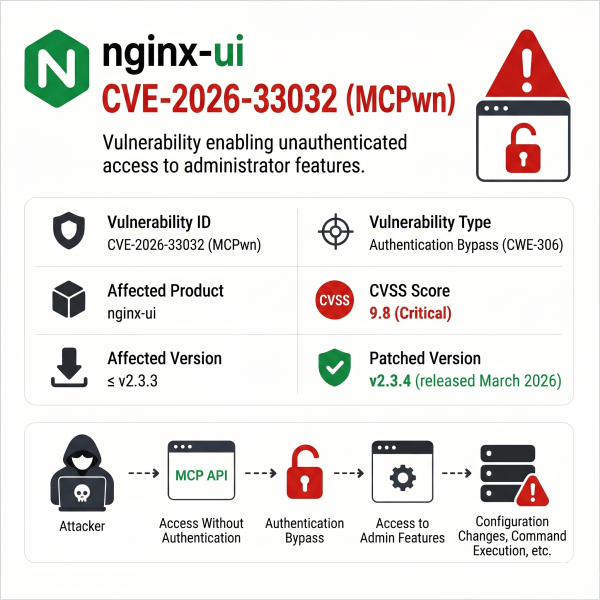
CategoryDescriptionVulnerability IDCVE-2026–33032 (MCPwn)Affected Productnginx-uiVulnerability TypeAuthentication Bypass (CWE-306)CVSS Score9.8 (Critical)Affected Version≤ nginx-ui v2.3.3Patched Version
v2.3.4 (released March 2026)Exploitation StatusConfirmed active exploitation
nginx-ui is a tool that allows administrators to manage Nginx configurations through a web-based interface. With the recent addition of MCP functionality, it introduced AI-driven automation features. However, during this integration process, a flaw occurred where authentication checks were not properly applied to certain endpoints.
Underlying Issue: Absent Middleware Check
The MCP integration operates based on two HTTP endpoints:
- /mcp: Authentication + IP whitelist applied
- /mcp_message: Only IP whitelist applied (authentication missing)
The issue lies in the fact that the authentication middleware (AuthRequired()) was not applied to the /mcp_message endpoint.
Additionally, the default IP whitelist is empty, and the system interprets this as “allow all” access. As a result, in the default configuration, /mcp_message is effectively exposed as a fully unauthenticated endpoint. This means that a single request can lead to full control of the Nginx server.
The patch (v2.3.4) was relatively straightforward: authentication middleware was added to /mcp_message, ensuring that both endpoints require authentication. If this had been implemented from the beginning, the vulnerability would not have existed. This makes nginx-ui MCPwn a classic example of how a single missing line of code can result in complete server compromise.
Full Attack Chain: Leveraging CVE-2026–27944 in External Environments
While CVE-2026–33032 alone allows unauthenticated attacks within internal networks (LAN), chaining it with CVE-2026–27944 (CVSS 9.8) enables full unauthenticated server compromise from the internet. CVE-2026–27944 is a vulnerability that allows attackers to download backup data without authentication via the /api/backup endpoint. This can expose sensitive information such as:
- User account information
- SSL private keys
- Nginx configurations
- node_secret (MCP authentication key)
Using this information, attackers can decrypt backup data, obtain the node_secret, create sessions via /mcp, and execute commands through /mcp_message. In summary, with just two requests, an attacker can achieve full control over the server.
Scenario of Exploitation
Following the public disclosure of the vulnerability and the release of PoC code, the observed attack flow is as follows:
- Identification of internet-exposed nginx-ui instances
- Extraction of sensitive data via access to /api/backup
- MCP session creation and authentication bypass
- Manipulation of Nginx configurations
This can lead to further attacks such as:
- Traffic interception and malicious redirection
- Theft of administrator credentials
- Web shell deployment and persistence establishment
- Service disruption
This is not just a simple vulnerability exploitation, it is an attack scenario that can result in full compromise of the entire web infrastructure. Yotam Perkal of Pluto Security noted that when MCP is added to existing applications, MCP endpoints inherit all application functionality but do not necessarily inherit security controls. He explained that this effectively creates a backdoor capable of bypassing carefully implemented authentication mechanisms.
CVE-2026–33032 is not the first MCP-related vulnerability. The same research team disclosed vulnerabilities in the Atlassian MCP server (mcp-atlassian), CVE-2026-27825 (CVSS 9.1) and CVE-2026-27826 (CVSS 8.2), which could be chained to achieve unauthenticated remote code execution within local networks. Between January and February 2026, more than 30 MCP-related CVEs were reported, with approximately 13% classified as authentication bypass issues. This trend highlights a recurring structural problem: security controls are not consistently applied when integrating AI-related features into existing applications.
nginx-UI Assets Exposed to the Internet: Insights from Criminal IP
To assess the real-world exposure of nginx-ui instances, externally exposed assets were identified and analyzed using Criminal IP.
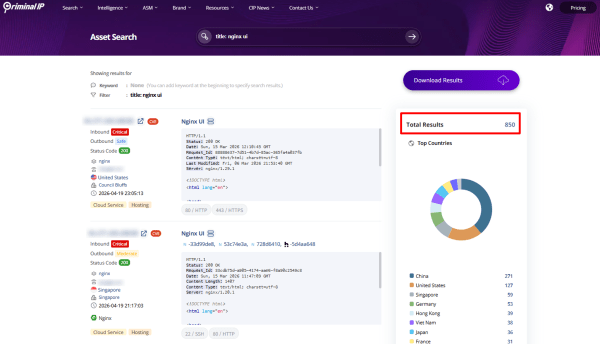
Criminal IP Search Query: title: nginx ui
The nginx-ui web console exposes its service name directly in the page title, making it possible to effectively detect externally accessible management interfaces using simple HTML title–based searches. This query identifies all nginx-ui management console instances exposed to the internet, regardless of whether the MCP feature is enabled. It can also be used to identify assets affected by CVE-2026–27944 (unauthenticated access to /api/backup) and is useful for simultaneously identifying targets vulnerable to chained attacks.
Based on this query, approximately 800 exposed assets were identified as of April 2026. These are not merely exposed systems, they represent management interfaces directly accessible from the internet. In scenarios where both vulnerabilities are chained, these assets can become immediately exploitable high-risk targets without additional conditions.
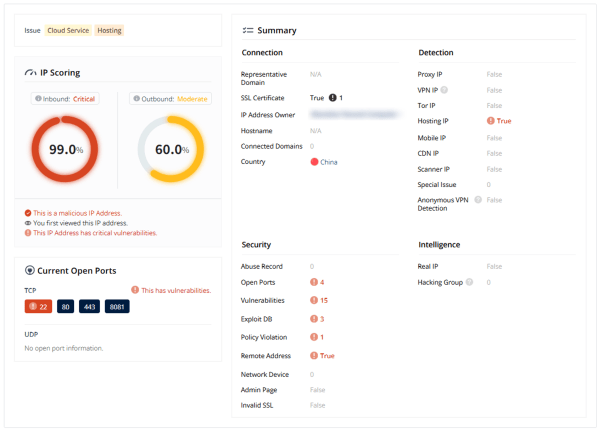
The example above shows a detailed Criminal IP analysis of one such exposed nginx-ui asset. The analyzed asset was assessed as high risk, with inbound traffic likely associated with malicious activity. Notably, multiple ports, including SSH (22), HTTP (80), and HTTPS (443), were simultaneously open. This indicates that both management and service functions are exposed, providing multiple accessible entry points for attackers. In addition, 15 vulnerabilities and related Exploit DB entries were identified, suggesting that the environment is not only exposed but also susceptible to known attack techniques.
If the nginx-ui vulnerability (CVE-2026–33032) exists in such an environment, attackers can exploit the management interface to modify configurations, manipulate traffic, and control services — expanding the scope of compromise. In conclusion, this asset represents a high-risk attack surface combining multiple exposed ports, known vulnerabilities, and accessible management interfaces.
Response and Mitigation Guidance
CVE-2026–33032 was fixed in nginx-ui v2.3.4, released in March 2026. The patch added authentication middleware to the /mcp_message endpoint and ensured consistent authentication across all MCP-related endpoints. The chained vulnerability CVE-2026-27944 was patched in v2.3.3, so updating to at least v2.3.4 is required to fully mitigate both issues. However, as some version tracking sources show discrepancies, it is recommended to verify patch status based on official release notes.
For environments where immediate updates are not feasible, the following temporary mitigation measures are recommended:
- Verify and enforce authentication on the /mcp_message endpoint
- Change the default IP whitelist policy from allow-all to deny-all
- Block external access to the nginx-ui management port (default: 9000)
- Restrict network-level access to the /api/backup endpoint
- Inspect Nginx configuration files (conf.d/, sites-enabled/) and access logs for unauthorized changes
Since this vulnerability can lead to configuration manipulation and traffic control, not just service disruption, organizations should also rotate credentials and sensitive information if compromise is suspected.
Behavior-based checks should include:
- Monitoring /mcp_message call history and detecting abnormal API requests
- Identifying unexpected changes in Nginx configuration files
- Checking for abnormal traffic redirection or proxy configurations
- Analyzing Nginx process restart and reload history
The key issue is not just patching, but determining whether management interfaces and configuration control capabilities were exposed externally. Therefore, mitigation must include both patching and continuous monitoring of exposed assets and access controls.
Conclusion
CVE-2026–33032 (MCPwn) is significant in two key aspects. Technically, a single missing middleware line resulted in full Nginx server compromise. From a security trend perspective, it highlights a recurring pattern where AI-integrated features introduce new attack surfaces that bypass existing security controls. Organizations using nginx-ui should immediately update to v2.3.4 and verify whether their instances are externally accessible. With many instances exposed to the internet and PoC code publicly available, any unpatched asset can quickly become a target. Ultimately, beyond knowing that a vulnerability exists, the more critical factor is understanding where vulnerable assets are exposed.
In relation to this you can refer to CVE-2026–34197: Apache ActiveMQ RCE Vulnerability Analysis
CVE-2026–33032 Analysis: Nginx Server Breach Through Missing MCP Authentication Controls was originally published in OSINT Team on Medium, where people are continuing the conversation by highlighting and responding to this story.