
Author: Berend Watchus. Independent non-profit AI & Cybersecurity researcher.

[*Of course, reality looks much less Hollywood, now. We’re not talking about humanoid robots stalking through rubble. The actual systems are software making targeting recommendations, drones loitering over a battlefield deciding when to strike, or unmanned ground vehicles and tanks operating without crews inside. The decision-maker is a server rack and a model weight file, not a guy in sunglasses. In some ways that’s harder to grapple with, because there’s no single figure to point at when something goes wrong, just a chain of code, sensors, and protocols. The survey suggests the public intuitively senses this, which is why the discomfort spikes specifically when human oversight disappears from the loop, regardless of what the machine looks like.]
examples:
Public Opinion on Military AI: What Nine Countries Reveal About the Political Landscape for Defense Technology
Introduction
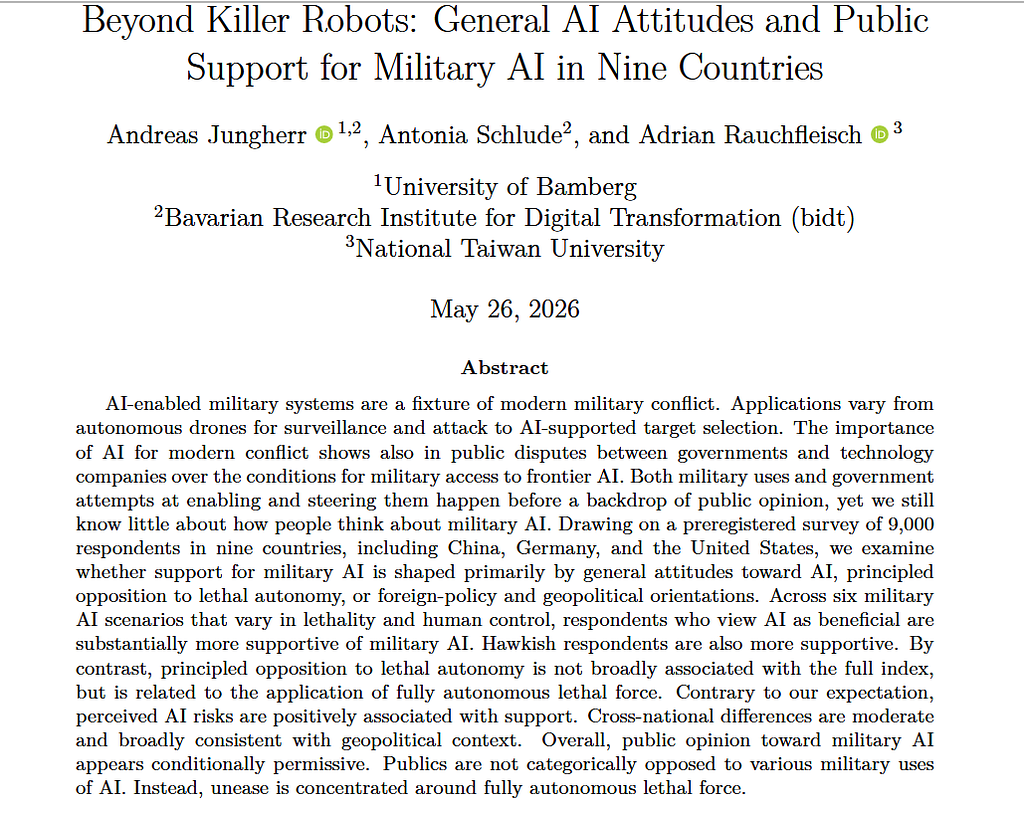
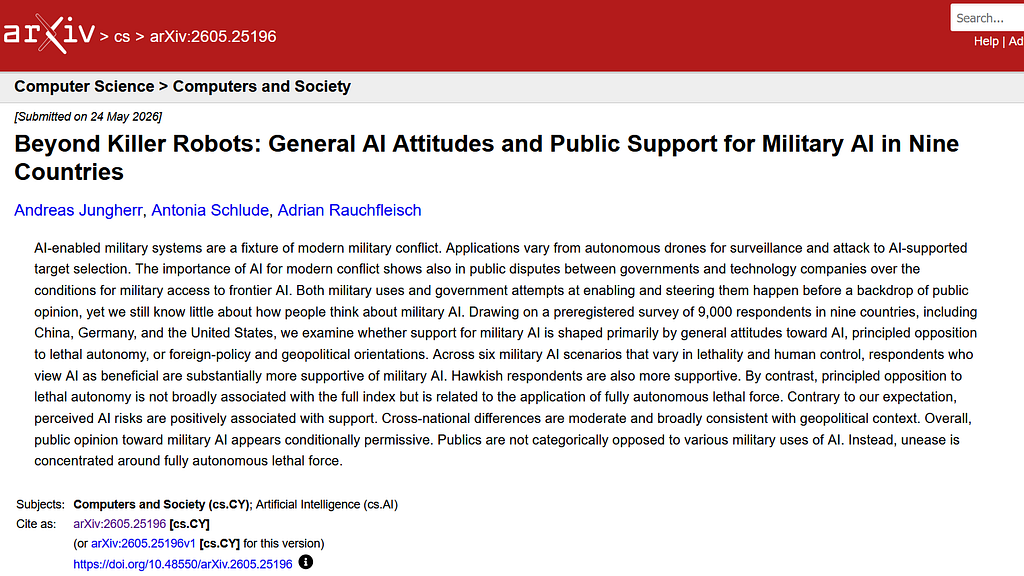
A new peer-reviewed study titled “Beyond Killer Robots: General AI Attitudes and Public Support for Military AI in Nine Countries” offers the most comprehensive cross-national snapshot to date of how citizens view the military use of artificial intelligence. Published in May 2026, the research arrives at a moment when AI has moved from speculative defense concept to operational reality, evident in Ukraine’s drone warfare, the reported use of AI-enabled target selection in recent US strikes against Iran, and the very public dispute between the Pentagon and AI lab Anthropic over military access to frontier models.
For executives, policymakers, and defense-sector leaders, the central question the paper addresses is consequential: does the public broadly oppose military AI, or is the opposition concentrated on specific applications? The answer shapes the political opportunity space within which governments, defense contractors, and technology companies must operate.
Who Conducted the Research
The study was authored by Andreas Jungherr and Antonia Schlude of the University of Bamberg and the Bavarian Research Institute for Digital Transformation (bidt), together with Adrian Rauchfleisch of National Taiwan University.
Funding came from the bidt, with additional support for one of the researchers from Taiwan’s National Science and Technology Council and the Taiwan Social Resilience Research Center, funded through the Higher Education Sprout Project by Taiwan’s Ministry of Education. The study received ethics approval from the University of Bamberg’s Institutional Review Board and was preregistered, meaning the hypotheses and analytical approach were locked in publicly before any data was collected. This is a methodological gold standard that limits the risk of cherry-picked findings.

How the Research Was Conducted
The international polling firm Ipsos fielded the survey in January 2026 as part of the bidt digitalbarometer.international 2026. The team surveyed 9,000 respondents, 1,000 in each of nine countries: China, Finland, France, Germany, Italy, Spain, Taiwan, the United Kingdom, and the United States. The country mix was deliberate, capturing leading AI ecosystems (US, China, Taiwan), publics directly exposed to security threats (Finland, Taiwan), and major European democracies operating within NATO and the EU.
Respondents were asked to evaluate six different military uses of AI, designed to vary along two dimensions that matter ethically and operationally:
how lethal the application is,
and how much decision-making authority is handed from humans to machines.
The applications ranged from analyzing satellite imagery to identify supply routes, to fully autonomous defense systems that detect and destroy enemy units without any human in the loop.
To explain what drives opinion, the researchers also measured general perceptions of AI’s benefits and risks, principled moral opposition to lethal autonomous weapons, hawk-dove orientations toward military force, confidence in the international rules-based order, and trust in major global powers (the US, China, and Russia). Standard demographic controls were included. The analysis used Bayesian multilevel modeling, which allowed the researchers to separate patterns shared across countries from those specific to national contexts.
Key Findings
The public is not categorically opposed to military AI. Across all nine countries, average support for military uses of AI sat above the midpoint of the scale. This contradicts the framing often dominant in elite and media discourse, which portrays public sentiment as broadly hostile to defense AI.
However, opposition crystallizes around one specific case: fully autonomous lethal force. In every country, fully autonomous lethal AI ranked as the least acceptable application. But only in the United Kingdom did the average score actually fall into the ‘unacceptable’ range; elsewhere, even this most controversial use received tepid but net-positive support.
This finding reinforces the continuing importance of “meaningful human control” as a public-opinion red line.

General attitudes toward AI are the strongest predictor of support. People who view AI as broadly beneficial for society are substantially more supportive of military AI. This effect dwarfs principled opposition to lethal autonomy across the six-item index, by a factor of roughly thirty. The authors capture this with a memorable line: experience with smart toasters may matter more than fears of killer robots in shaping how the public views military AI.
Hawk-dove orientations matter independently. Citizens who view military force as a legitimate instrument of statecraft support military AI more strongly, regardless of their general views on the technology. This is a separate channel of support that defense planners and AI developers should understand as distinct from technology optimism.
Perceived AI risks correlate positively, not negatively, with military AI support. This counterintuitive finding suggests a security-dilemma logic at work: if citizens believe AI is powerful and potentially dangerous, they may want their own country to develop it precisely because adversaries will.
Geopolitical context produces selective effects. Distrust of Russia drives support for military AI in Germany, Italy, Spain, and Finland. Trust in the United States increases support in the US itself and in the United Kingdom. Trust in China showed no clear pattern. These findings underscore that military AI attitudes are filtered through specific security relationships, not generic geopolitics.
Cross-national differences are smaller than expected. Only about five percent of variation in support sits between countries; the rest is within countries. Despite very different security environments, AI ecosystems, and political systems, the underlying structure of public opinion looks remarkably similar across the nine publics studied.
What This Means for Decision-Makers
The picture that emerges is what the authors call a “conditionally permissive consensus.” The public is not categorically opposed to military AI, but it is not unconditionally supportive either. Acceptance declines sharply when lethal force is combined with the removal of human oversight.
Three implications stand out for those navigating this space.
First, the political opportunity for military AI is shaped more by general AI discourse than by specialist debates about autonomous weapons. Civilian AI controversies, governance fights, and everyday user experiences with AI products are likely to spill over into how the public evaluates defense applications. The reputational health of the broader AI industry matters for defense AI in ways that may not be fully appreciated.
Second, the “killer robot” frame, while real and resonant, applies narrowly. Civil-society campaigns and policy debates focused exclusively on lethal autonomous weapons may be missing the broader picture of public opinion, which differentiates substantially between use cases.
Third, the structure of support is broadly similar across the nine democracies and one authoritarian state surveyed. This suggests that companies and governments developing military AI face a relatively coherent public-opinion environment across major Western markets and key Indo-Pacific actors, with national geopolitical contexts modulating, rather than fundamentally restructuring, that environment.
Limitations Worth Noting
The authors are careful to flag what their study cannot do. The design is cross-sectional, meaning causal claims are not warranted. The sample excludes active conflict zones (notably Ukraine) and several states central to military AI development, including Russia, Israel, India, Japan, South Korea, and Turkey. The measure of principled opposition captures categorical moral rejection rather than conditional or outcome-based skepticism. And while public opinion sets the environment in which defense AI develops, the study does not directly observe how policymakers translate that opinion into policy.
Conclusion
For boardrooms grappling with the strategic, ethical, and political dimensions of AI in defense, this study offers an empirically grounded baseline. Public opinion is neither the prohibitive force that some advocacy framing suggests, nor a blank check. It is conditionally permissive, sensitive to questions of human control, and shaped substantially by attitudes toward AI more broadly. Understanding this landscape, rather than assuming it, is increasingly essential as military AI moves from policy debate to operational reality.
public opinion study‘Beyond Killer Robots…’ was originally published in OSINT Team on Medium, where people are continuing the conversation by highlighting and responding to this story.