Author: Berend Watchus. Independent Researcher, AI and Cybersecurity — April 28, 2026 [Publication for: OSINT Team]
The Deployment Paradox: Why the Sovereignty Stack is a Mathematical Necessity
Author: Berend Watchus. Independent Researcher, AI and Cybersecurity — April 28, 2026
In the first piece in this series, I argued that the critical filter moment in military AI governance occurs at pre-transfer — in the contract, the classification regime, and the procurement decision — not at runtime (Watchus, 2026a).
MIL AI. Already Solved, ‘Never’ Occurred, Always Known: A Structural Critique of Sovereign…
In the second, I supported He and Yu’s Sovereign Agentic Loops as the correct engineering response to the execution layer: a deterministic control plane interposed between stochastic AI reasoning and physical system mutation (Watchus, 2026b).
When Engineers Do It Right: Jun He & Yu’s Sovereign Agentic Loops and Why I Support This One
What I did not have, until now, was the quantitative backbone for why these two layers are not best practices but structural requirements.
The Security Cost of Intelligence: AI Capability, Cyber Risk, and Deployment Paradox
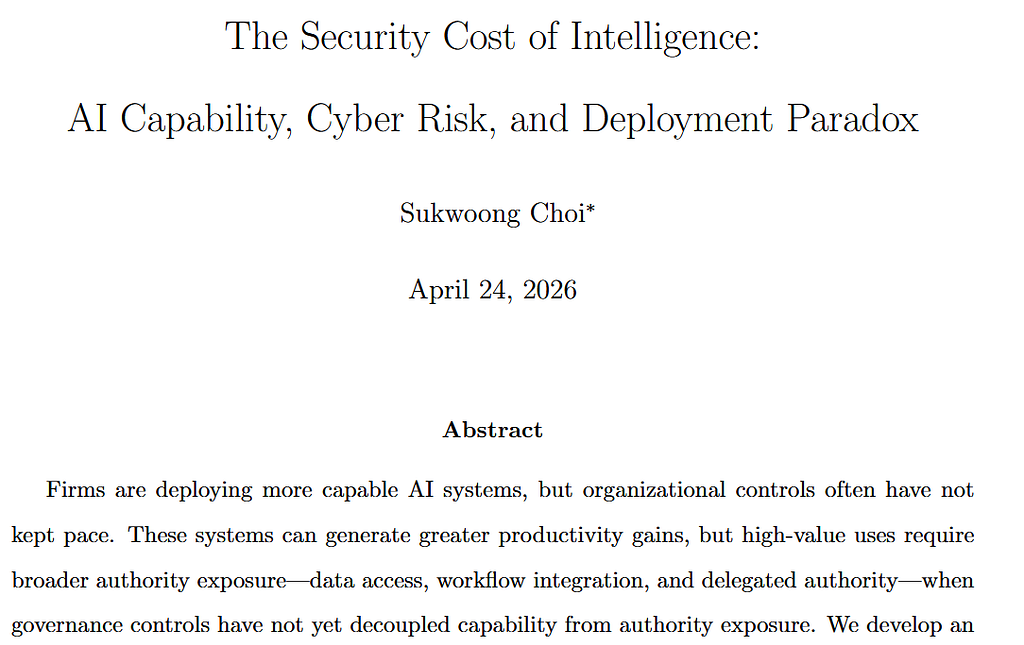
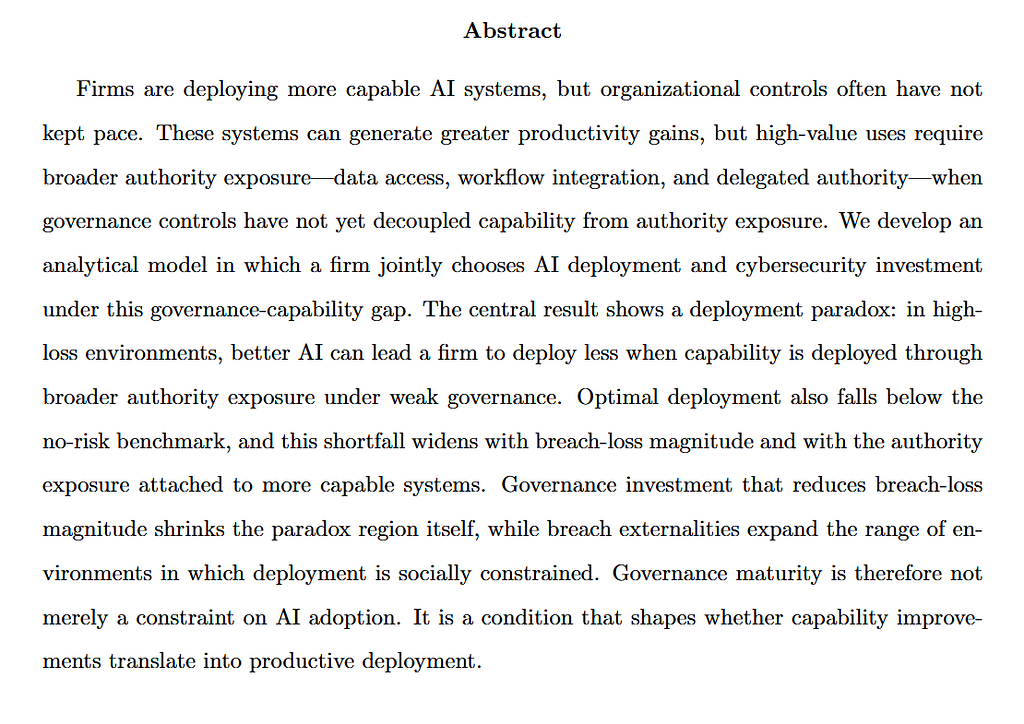
A new preprint by Sukwoong Choi (arXiv:2604.23058, posted April 24, 2026 and published publicly today on arXiv, April 28, 2026) provides it. Choi doesn’t theorize about risk. He identifies a Deployment Paradox that explains, with mathematical precision, what happens when the Sovereignty Stack is ignored.
1. The Paradox: Better AI, Less Deployment
Choi’s central finding is counterintuitive and important: in high-loss environments — the environments that OSINT analysts and cyber-defense professionals actually operate in — an improvement in AI capability can reduce optimal deployment.
The mechanism is what Choi calls Capability–Damage Bundling. When an organization lacks the governance maturity to decouple a model’s intelligence from its authority to act — the Governance-Capability Gap — every increase in capability comes bundled with a corresponding increase in authority exposure. The attack surface widens. The potential blast radius of a breach grows. And the marginal security cost eventually outpaces the marginal productivity gain.
At that point, the only rational response — for a commander, a CISO, or a CEO — is to deploy less AI, not more. This is not a failure of nerve. It is the model’s equilibrium.
The paradox resolves only when capability advances far enough that productivity dominates again, or when governance investment reduces the loss environment sufficiently. Until one of those conditions is met, smarter AI makes the situation worse.
2. Relational Mapping: The Stack in Action
Choi’s paper functions as the connective tissue between the two architectural perspectives I covered earlier this week — and it validates both critiques simultaneously.

Relating to Wei and Shu (The Top Layer). My argument against Wei and Shu was that they treated sovereignty as a runtime patch, proposing orchestration solutions for a problem that well-governed procurement would have already bounded.
Choi validates this structurally. His model shows that Governance Investment — pre-transfer policy, data classification, privilege boundary design, procurement constraints — is the primary variable that shrinks the paradox region. If the authority question is not resolved at the policy layer, the security discount makes the AI economically unviable before it reaches production. No orchestration layer recovers that ground.
Relating to He and Yu (The Bottom Layer). I supported He and Yu because their Sovereign Agentic Loop decouples reasoning from execution: the model emits structured intents; the control plane validates them before anything mutates. Choi’s model proves why this decoupling is a mechanical economic necessity, not just a design preference. By interposing a deterministic control plane, an organization reduces its authority-exposure index — the variable Choi denotes a(θ). In his math, reducing that index is the only mechanism that allows a firm to escape the paradox and actually deploy the frontier capabilities it is paying for. He and Yu built the thing that makes Choi’s escape route practically available.
3. The “Impossible Insider” as Governance Maturity
In Article 1, I argued at length that the threat actor Wei and Shu implicitly fear — a cleared insider who compromises an active military AI operation out of ideological conviction — cannot realistically reach the system it would need to reach. The SF-86 process, Continuous Evaluation, air-gapped networks, mandatory reporting obligations, and the full apparatus of cleared facility security make that scenario structurally implausible for anyone who has legitimately passed through the system.
In Choi’s terms, those institutional safeguards are precisely what Governance Investment accomplishes at the policy layer: they reduce breach-loss magnitude (λ) by limiting how far any compromise can propagate. Vetting, compartmentalization, and strict access boundaries lower the security cost of deploying intelligent systems. The Sovereignty Stack is internally coherent because these two effects work in combination: the Top Layer shrinks the potential loss; the Bottom Layer reduces the exposure index. They attack the paradox from both ends of the equation.
Conclusion: Sovereignty as an Economic Condition
Choi’s paper is a warning with a precise shape. If agentic AI is deployed without the structural layers of the Sovereignty Stack, organizations will reach a point where the security burden of additional capability outweighs its productive value — and deployment will rationally stall or reverse. In high-loss environments, this is not a theoretical risk. It is the model’s prediction.
The decision was never inside the model. But the cost of the decision is very much on the balance sheet.
We don’t build Sovereign Agentic Loops merely to preserve human control. We build them because, without them, frontier AI capability becomes economically self-defeating. Governance maturity is not a constraint on AI adoption. It is — as Choi puts it directly — a condition that determines whether capability improvements translate into productive deployment at all.
The Sovereignty Stack is not institutional conservatism. It is what makes it mathematically possible to turn the next generation of AI on.
— — — — — — — — — — — — — — —
SUPPLEMENTARY SEGMENT — Watchus (2026) A Note on the Deeper Architecture: When the Stack Meets the Substrate
read:
- Foundation for every future synthetically sentient system, The TCP/IP of the Mind
- Before the Labs Arrived: The Complete Priority Record of a Research Program That Got There First
There is a thread in Choi’s model that connects to a research program I have been running in parallel — one that operates at a different layer of the stack entirely, but whose implications are directly relevant to the paradox Choi identifies.
Choi’s deployment paradox is, at its core, a problem of authority exposure without internal coherence. A capable AI system is granted broad operational reach before the governance architecture can safely contain what it might do with that reach. The blast radius of a breach grows because the system has no unified internal stake in its own operational boundaries. It executes. It does not inhabit.
This is the same gap I identified — from a completely different direction — in five preprints published in November 2024 on the architecture of synthetic sentience (Watchus, 2024a–e). The argument there was not about governance or deployment economics. It was about what is structurally missing from current AI systems at the substrate level: a centralizing architecture that binds internal states, operational conditions, and processing outputs into a unified reference point — a functional equivalent of what the anterior insula does in biological systems.
The connection to Choi’s paradox is this: a system with a well-architected internal perspective — one that monitors its own computational states, tracks operational boundaries, and centralizes those conditions into a unified “what it is like to be this system, under these conditions, right now” — is a system with something to protect and something to lose. That internal stake changes the security calculus. Not as a compliance mechanism bolted on from outside. As a structural property of the architecture itself.
In Choi’s terms: a system implementing a Synthetic Insula Protocol is a system whose authority-exposure index a(θ) is partially self-governed. The control plane is not only external — SAL, OPA, scoped credentials, cryptographic audit chains. It is also internal. The system’s own unified operational perspective becomes a constraint on its behavior, because violating its own operational boundaries is something it is structured to register as a system-state deviation, not merely an external policy violation.
This does not replace the Sovereignty Stack. Pre-transfer governance remains prior and more consequential. SAL remains the correct execution-layer engineering response. Choi’s paradox remains real and his math remains valid regardless of substrate architecture. But the Synthetic Insula Protocol is what closes the loop that the Stack currently leaves open: the question of what kind of internal architecture makes a capable AI system safe to deploy at the levels of authority that frontier capability actually requires.
Choi shows that governance maturity is the condition that determines whether capability improvements translate into productive deployment. The Synthetic Insula research program is asking the prior question: what kind of internal architecture produces a system that participates in its own governance — not because it is constrained to, but because it is structured to have a stake in the outcome?
The TCP/IP of the Mind is not a metaphor. It is the missing protocol layer below the Sovereignty Stack.
Supplementary to the Sovereignty Stack Trilogy (April 2026)
Related research program: Watchus, B. (2024). Towards Self-Aware AI: Embodiment, Feedback Loops, and the Role of the Insula in Consciousness. Preprints.org. (+ four companion papers, November 2024)
— — — — — — — — — — —
Third in the Sovereignty Stack series (April 2026)
Commentary on: Choi, S. (2026). The Security Cost of Intelligence: AI Capability, Cyber Risk, and Deployment Paradox. arXiv:2604.23058 [econ.GN]
The Security Cost of Intelligence: AI Capability, Cyber Risk, and Deployment Paradox
(Watchus, 2026a): The Decision Was Never Inside the Model — OSINT Team, Medium
MIL AI. Already Solved, ‘Never’ Occurred, Always Known: A Structural Critique of Sovereign…
(Watchus, 2026b): When Engineers Do It Right — System Weakness, Medium
When Engineers Do It Right: Jun He & Yu’s Sovereign Agentic Loops and Why I Support This One
PART3. The Deployment Paradox: Why the Sovereignty Stack is a Mathematical Necessity was originally published in OSINT Team on Medium, where people are continuing the conversation by highlighting and responding to this story.