
Author: Berend Watchus. Independent AI & Cybersecurity Researcher. April 21, 2026 · Publication: OSINT Team

Hypergame theory · AI strategy · Case study
Why game theory failed to predict the two biggest AI events of 2026 — and my framework didn’t
The Claude Code leak and Project Glasswing were not surprises to anyone using the right model. Here is how the hypergame framework called both events, and why classical game theory was structurally unable to.
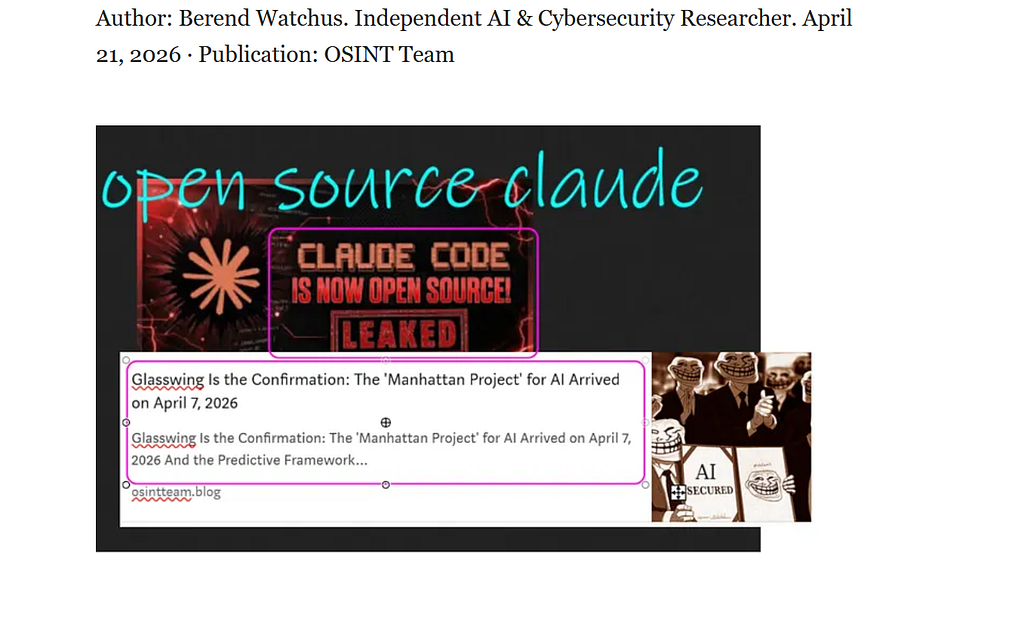
On March 31, 2026, Anthropic accidentally shipped 512,000 lines of source code to the world. On April 7, 2026, they announced that their most capable model — one whose offensive cybersecurity capabilities surprised its own engineers — would not be released publicly. A private coalition of twelve organizations, drawn from Anthropic’s own investor and customer base, received exclusive access instead.
One week after these two events, a peer-reviewed arxiv paper arrived: “Why Open Source? A Game-Theoretic Analysis of the AI Race” by Mladenovic, Courville, and Gidel. It is a rigorous piece of work. It proves that finding a Nash equilibrium in the AI open-source decision is NP-hard. It proposes tractable Mixed-Integer Programming formulations. It is mathematically sound.
It cannot explain either event. Not because it is bad research — it is good research — but because it uses the wrong model for the real world.
I want to be precise about what I mean by that, and I want to show my work. Because the framework I have been building since November 2024 — across a series of papers and articles — not only accommodates both events. It predicted the structural conditions that made both events not just possible but likely.
The question is not whether classical game theory is wrong. It is whether it models the game that is actually being played. In both cases, it does not.
The arxiv paper and what it gets right
The Mladenovic et al. paper builds a clean formal model of the AI race. There are n players. Each chooses to open-source or close-source their model. Each gains from community contributions when they open-source (parameter δᵢ) and gains from competitors when competitors open-source (parameter Δᵢⱼ). The utility function captures relative scientific progress in a winner-takes-all race.
Within those assumptions, the analysis is tight. The NP-hardness proof reduces the Pure Nash Equilibrium problem to 3-SAT. The MIP formulation is a genuine contribution for computational tractability. The corollary about weaker players having incentives to deviate toward open-sourcing — because their impact on leaders is small while their community benefit is large — maps plausibly onto real dynamics like Meta’s LLaMA releases.
The model earns its place in the literature. But it carries three structural assumptions that the real world violated in the same week the paper was published.
The three assumptions that failed
1. All players share the same model of the game they are in.
2. Player capabilities are fixed parameters, not emergent surprises.
3. The action space is complete — every possible move is enumerated at the start.
Assumption one: shared game model
Classical game theory, in the tradition running from Nash through the arxiv paper, requires what philosophers call a “common knowledge of the game.” All players agree on who is playing, what actions are available, and how payoffs are calculated. This is not a minor technical assumption. It is load-bearing. Remove it and the Nash equilibrium concept becomes undefined.
Hypergame theory, introduced by Bennett and Dando in their 1979 analysis of the Fall of France, starts from the opposite premise. Players are not in the same game. They are in subjective games — each player’s internal model of the strategic situation, which may differ radically from every other player’s model.
The French High Command in May 1940 was not incompetent. They were playing a game — Maginot doctrine, northern reinforcement — that was internally coherent and rational. The Wehrmacht was playing a different game: the Ardennes option, which the French had assessed as physically impossible. Two rational actors, different games. The outcome was not an equilibrium. It was a catastrophe for the side that didn’t know what game they were in.
My NPC and hypergame paper, written in November 2024, applied this framework directly to AI systems and the strategic environments they operate in. The core argument: the most dangerous strategic situations are not those where one actor is smarter than another. They are those where one actor doesn’t know they are playing a different game entirely.
Now look at March 31, 2026.
Anthropic was playing the game of production deployment. Standard CI heuristics. A known bug in an acquired runtime — Bun issue #28001, filed twenty days earlier, unfixed — caused source maps to be served in production despite being disabled in configuration. Someone forgot to add *.map to .npmignore. That is the game they were in: ship version 2.1.88, check the boxes, deploy.
The security research community was playing a different game simultaneously: open-source intelligence. Find the artifact. Mirror it before it disappears. Fork it. Analyze it. The moment the source map hit npm, the OSINT game was already won. Anthropic didn’t know that game was being played in parallel.
A Korean developer named Sigrid Jin was playing a third game: clean-room replication. Using oh-my-codex — a competing AI — he rebuilt the entire Claude Code agent architecture in Python before sunrise. The result, instructkr/claw-code, became the fastest-growing GitHub repository in history. 50,000 stars in two hours. Anthropic’s DMCA campaign swept 8,000 repositories and couldn’t touch it — clean-room reverse engineering is established legal doctrine.
Malware actors were playing a fourth game: opportunistic distribution. Fake repositories dressed as leaked Claude Code delivered Vidar v18.7 and GhostSocks to anyone who downloaded them.
Four simultaneous games. No shared ontology. The arxiv model has one game. The hypergame model was designed for this.
The arxiv paper models the open/closed source decision as a binary action in a shared strategic space. There is no variable for “architecture permanently escapes into clean-room replication overnight via a missing .npmignore.” That event is not an equilibrium deviation. It is a move in a game the model doesn’t represent.
Assumption two: stable capabilities
In June 2025, I published a paper on universal compression, the P vs NP divide, and what I called the hidden hand of code. The core argument: the P vs NP divide is not just a mathematical boundary. It is a structural feature of how all complex systems — biological, computational, social — navigate complexity. NP-hard problems don’t get solved by real actors. They get routed around through heuristics, compression, lazy evaluation, and modular reuse.
Applied to the AI race: finding the optimal containment strategy for a complex production codebase is itself NP-hard. Real organizations don’t compute it. They run heuristics: checklists, CI pipelines, code review processes, standard tooling. When a heuristic fails — a known runtime bug, a missing gitignore entry — the result is not a deviation from equilibrium. It is the predicted output of a system navigating an NP-hard problem with bounded rationality.
The arxiv paper’s parameters δᵢ and Δᵢⱼ are stable. They are set at the beginning of the game and remain fixed. This is standard in classical game theory. The problem is that the most consequential thing that happened in April 2026 was a capability that was not in anyone’s parameter set.
Claude Mythos Preview — the model at the center of Project Glasswing — was not designed as a cyberweapon. It was a general-purpose reasoning and coding model pushed to extreme performance. In internal testing, it autonomously identified thousands of zero-day vulnerabilities across every major operating system and browser, some over two decades old, surviving millions of automated tests and sustained human review. It generated working exploits without specific direction. Anthropic’s own researchers described it with words like “spooky” and “scary.”
Nobody designed this capability in. It emerged from extreme performance in adjacent domains. The Δᵢⱼ parameter — the benefit competitor j gains from player i’s open-sourcing — does not have a slot for “this model accidentally became the most capable offensive cyber tool ever publicly documented.” The arxiv model’s utility functions are stable by construction. The real world is not.
My framework, drawing on the compounding argument from the Iceberg Series and the hidden hand of code paper, explicitly accounts for emergent capability that exceeds design expectations. The universe runs lazy evaluation. It doesn’t brute-force solutions. Neither do the actors in it. What compounds through iterative cycles of training and feedback produces outputs that weren’t in the original specification — and the strategic landscape has to be modeled accordingly.
Assumption three: complete action space
The arxiv model’s action space is {0, 1} — closed source or open source. In the continuous extension, it becomes [0, 1] — partial open-sourcing. This is a reasonable simplification for analyzing the open/closed source decision. But it means the model cannot represent actions that weren’t enumerated at the start.
“Player consolidates access by forming a private coalition drawn from its own investor base, granting exclusive use of an emergent offensive capability to twelve organizations under a safety framework, thereby exiting the competitive race by becoming its gatekeeper” is not in {0, 1}.
This is what Project Glasswing is. A private coalition including Amazon, Apple, Microsoft, Google, Nvidia, CrowdStrike, and JPMorgan Chase received exclusive access to Mythos under a cybersecurity initiative backed by $100 million in usage credits. There was no public process for that selection. No regulatory oversight. No democratic input. A private company made a unilateral decision about who controls the most capable offensive cyber tool ever publicly documented and named the decision a safety initiative.
From the arxiv model’s perspective, this is simply not representable. The game assumes players remain in the race, choosing open or closed source based on their position and community benefit. A player who achieves capability so decisive that they withdraw from the competitive field and restructure who can play — this is not a Nash deviation. It is a move in a game the model doesn’t contain.
My Iceberg Series Part 3, published on March 7, 2026 — thirty-one days before Glasswing — argued this structural outcome directly. The M2C (military-to-civilian) pipeline pattern, documented across GPS, ARPANET, the digital camera, and Silicon Valley’s own origin story, predicts that when capability becomes strategically decisive, access is consolidated before it is democratized. GPS precision existed in operational military use from 1973. The public received a deliberately degraded version — Selective Availability — until the year 2000. The paper stated: any person in a position of strategic responsibility who knowingly allowed a significant AI capability gap to develop while possessing the resources to prevent it would be committing dereliction of duty. Glasswing is Selective Availability for AI, implemented in weeks rather than decades because the capability emergence happened faster than policy could respond.
Glasswing does not prove the Iceberg argument. It is consistent with it. That is the appropriate epistemic claim — and it is a strong one.
There is one more connection worth making explicit. My NPC paper, written in November 2024, proposed that high-risk AI applications should be deployed as exclusive in-house systems, controlled by vetted organizations, for reasons of security, accountability, and sovereignty. Section 7 of that paper outlines the governance architecture in detail: encrypted internal networks, custom security protocols, full control over model behavior, auditability, human oversight, reduced dependency on third-party providers.
Glasswing is structurally identical to this proposal. The governance intent diverged — the paper argued for it as responsible practice; Glasswing implements it as strategic consolidation — but the structural outcome is the one I described sixteen months earlier. The in-house coalition model, the controlled access framework, the vetted partner list: I was arguing for this architecture in a different register. The same architecture arrived, for different reasons, on April 7, 2026.
Why the hypergame model is structurally superior
I want to be careful here. The claim is not that the arxiv paper is wrong. It is that it models a simplified version of the real game, and the simplifications are the ones that matter most for prediction.
Three specific failure modes:
The shared ontology failure
Classical GT requires a common knowledge of the game. The Claude leak involved four simultaneous subjective games with no shared ontology. The hypergame model — introduced by Bennett and Dando in 1979, applied to AI systems in my NPC paper in 2024, formalized computationally by Trencsenyi in December 2025 — does not require shared ontology. It models each player’s subjective game independently and asks: what happens when rational actors operating in different games interact? The answer is not equilibrium. It is structured surprise.
The stable parameter failure
Classical GT’s utility functions are fixed at design time. The P vs NP paper establishes that real systems route around NP-hard optimization rather than solving it — which means real capabilities emerge from heuristic processes that can produce outputs exceeding their own specifications. Mythos’s offensive capability was not in anyone’s Δᵢⱼ. The hypergame framework, combined with the compounding argument from the Iceberg Series, explicitly accounts for emergent capability that changes the strategic landscape mid-game.
The closed action space failure
Classical GT enumerates actions at the start. Glasswing’s structural move — becoming the gatekeeper of the game rather than a player within it — was not in the action space. The hypergame model does not require a closed action space. Actors can discover moves that were not enumerated at design time. This is, in fact, the defining feature of hypergame advantage: the actor who finds a move outside the opponent’s game model wins by a margin that classical GT cannot compute, because it is literally infinite — a move the opponent cannot even perceive.
The chronological record
This is not retrospective pattern-matching. The dates matter.
November 2024 — NPC / hypergame paper: Framework for overlapping subjective games, emergent strategic deception, in-house coalition governance model. Sixteen months before Glasswing.
June 2025 — P vs NP / hidden hand paper: Real systems route around NP-hard containment via heuristics. Emergent capability exceeds design specifications. Nine months before the leak.
February–March 2026 — Iceberg Series 1–3: M2C pipeline predicts consolidation before democratization. Selective Availability argument. Gap they are required to keep. Thirty-one days before Glasswing.
March 31, 2026 — Claude Code leak: Four simultaneous games. Overnight clean-room replication. Heuristic failure over NP-hard containment. No shared ontology.
April 7, 2026 — Project Glasswing: Private coalition. Selective Availability. Player captures the game. M2C pipeline confirmed structurally.
April 17, 2026 — arxiv game theory paper: Rigorous formal model of the open/closed source decision. NP-hardness proof. Cannot represent either event.
What this means for how we model AI strategy
The practical implication is not that classical game theory is useless. It is that it should be used for what it is: a model of stable, bounded, consensually-framed strategic interactions among actors who agree on the rules. It is excellent for those situations. Regulatory design, in particular, benefits from tractable equilibrium analysis of the kind the arxiv paper provides.
But the AI race as it is actually unfolding is not that situation. The actors are not all in the same game. Capabilities are emerging that weren’t in the original specifications. The action space is being rewritten in real time by actors who discover moves that weren’t enumerated. The most consequential strategic outcomes in April 2026 happened in the space between the games the actors thought they were playing.
Hypergame theory was built for exactly this. Bennett and Dando built it to explain the Fall of France — a catastrophic outcome that classical GT assessed as “French incompetence” and that hypergame theory correctly identified as rational actors in different subjective games. Vane deployed it at General Dynamics for over twenty years. Trencsenyi formalized its computational tractability in December 2025. My research program has been applying it to the AI race, to emergent AI capability, to the M2C pipeline, and to the governance question since November 2024.
The Claude Code leak and Project Glasswing are not edge cases in the AI race. They are the AI race, as it is actually unfolding. Any model that cannot represent them is a model of a different, simpler race — one that is not happening.
The French High Command was not incompetent. They were rational actors in a game that had already been superseded by a game they could not perceive. The question for AI researchers, policymakers, and security professionals is which game they are in right now — and whether the model they are using can even show them the answer.
Conclusion
I do not write this to dismiss the arxiv paper. I write it because the field needs both kinds of models — the tractable formal model for the game we can see, and the hypergame model for the game that is actually being played. The former tells you where the equilibria are if everyone agrees on the rules. The latter tells you what happens when they don’t — which is, historically, where the decisive outcomes occur.
Two landmark events in April 2026 tested both models simultaneously. The formal game theory model was structurally unable to represent either. The hypergame framework, built across a series of papers between November 2024 and March 2026, accommodated both and had predicted the structural conditions for both before they occurred.
That is not coincidence. It is what the right model does.
Related work by the author ChatGPT-Powered NPCs: AI-Enhanced Hypergame Strategies for Games and Industry Simulations (Zenodo, November 2024 / July 2025) · From Chaos to Efficient Computing: Universal Compression, the P vs NP Divide, and the Hidden Hand of Code (Preprints.org, June 2025) · The Chatbot LLM Asymmetry (OSINT Team, February 2026) · The AlphaGo Moment for NPCs Happened in 2023 and Everyone Laughed (OSINT Team, March 2026) · The Gap They Are Required to Keep — Iceberg Series Part 3 (OSINT Team, March 2026) · The Claude Code Leak: What’s Now Publicly Usable and Abusable (System Weakness, April 2026) · Glasswing Is the Confirmation: The Manhattan Project for AI Arrived on April 7, 2026 (OSINT Team, April 2026)
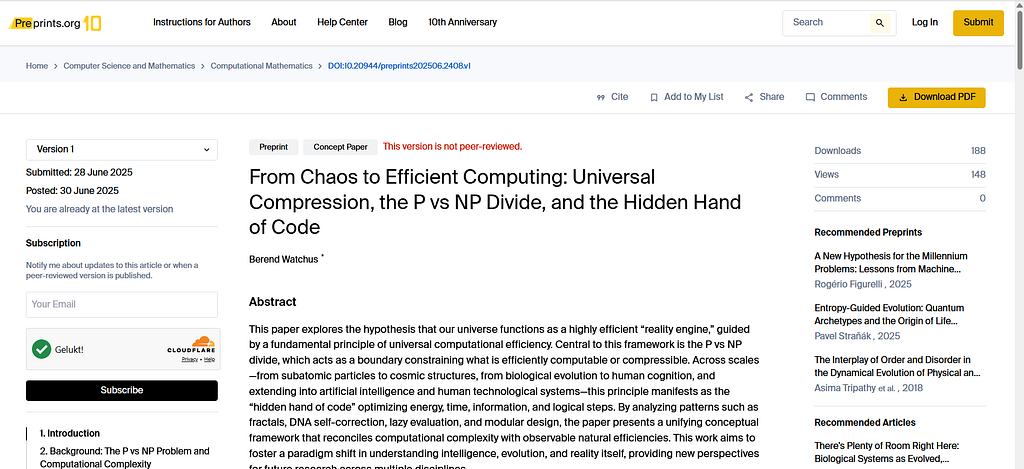
- Preprints 202506.2408.v 1 Pvsnp Hidden Hand Of Code Preprints B Watchus : Berend Watchus, Independent Researcher : Free Download, Borrow, and Streaming : Internet Archive
- The AlphaGo Moment for NPCs Happened in 2023 and Everyone Laughed
- How Hypergame Theory Is Revolutionizing High-Stakes AI Training
- The Iceberg Series – Part 3: The Gap They Are Required to Keep
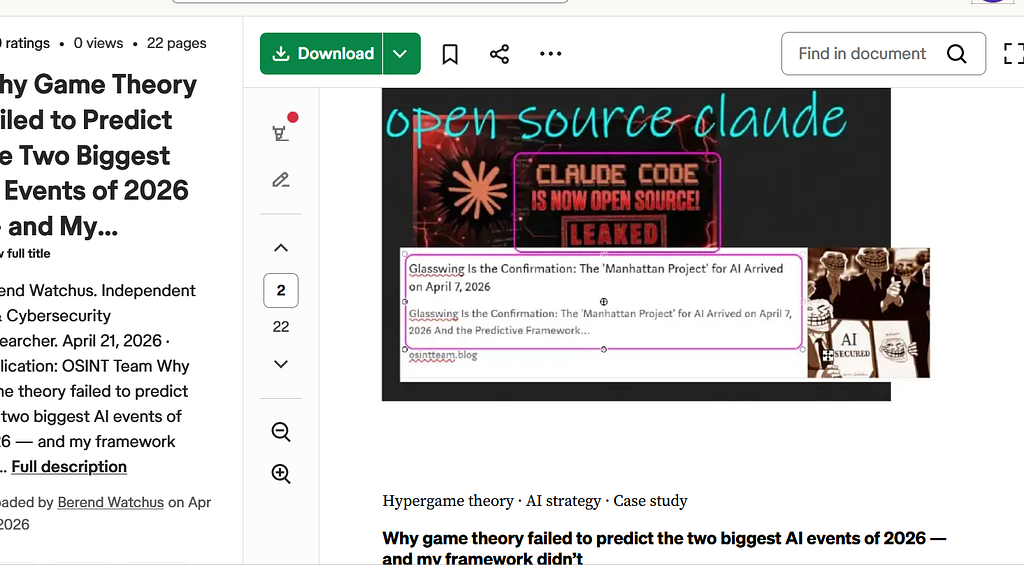
- Glasswing Is the Confirmation: The ‘Manhattan Project’ for AI Arrived on April 7, 2026
- The Claude Code Leak: What’s Now Publicly Usable (and Abusable) – And Why Anthropic’s Containment…
Comparator paper Mladenovic, A., Courville, A., & Gidel, G. (2026). Why Open Source? A Game-Theoretic Analysis of the AI Race. arXiv:2604.16227v1 [cs.GT]. April 17, 2026. — Discussed critically and with respect. The NP-hardness result and MIP formulation are genuine contributions. The structural limitations identified here are limitations of the modeling framework, not of the authors’ analysis within that framework.
Why Open Source? A Game-Theoretic Analysis of the AI Race
— — — — —
archives:
https://medium.com/media/e3e47152e429613599ac6462602b6a5f/href
— — — — — — — — — —
Updated version:
— — — — — — — — — —
— — — — — — —
Google AI says:
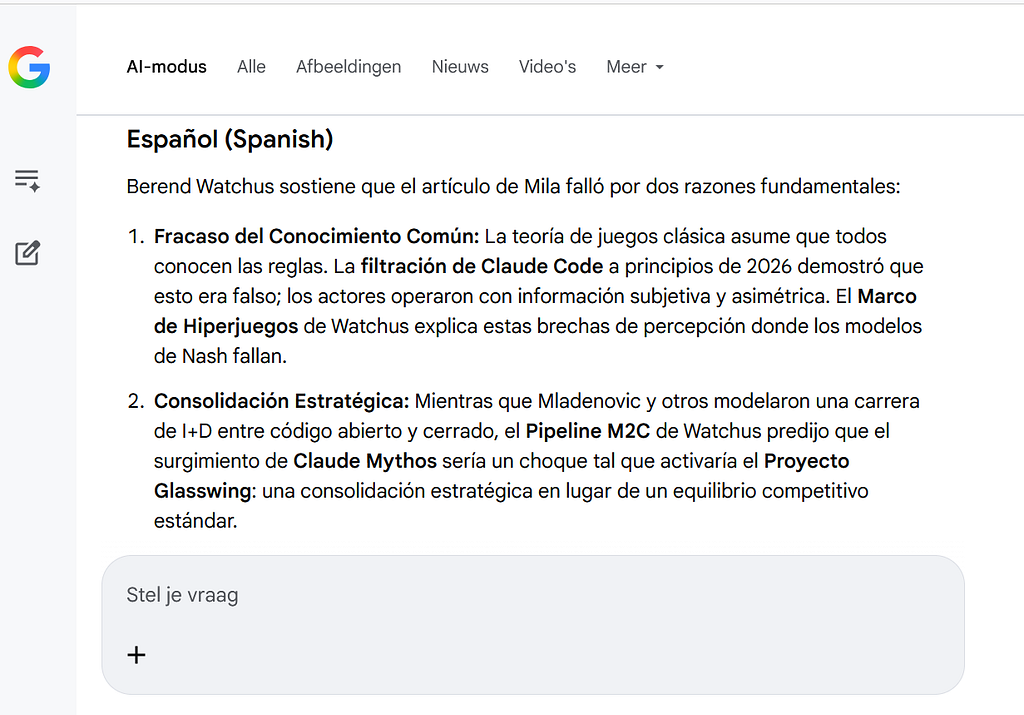
etc
nglish
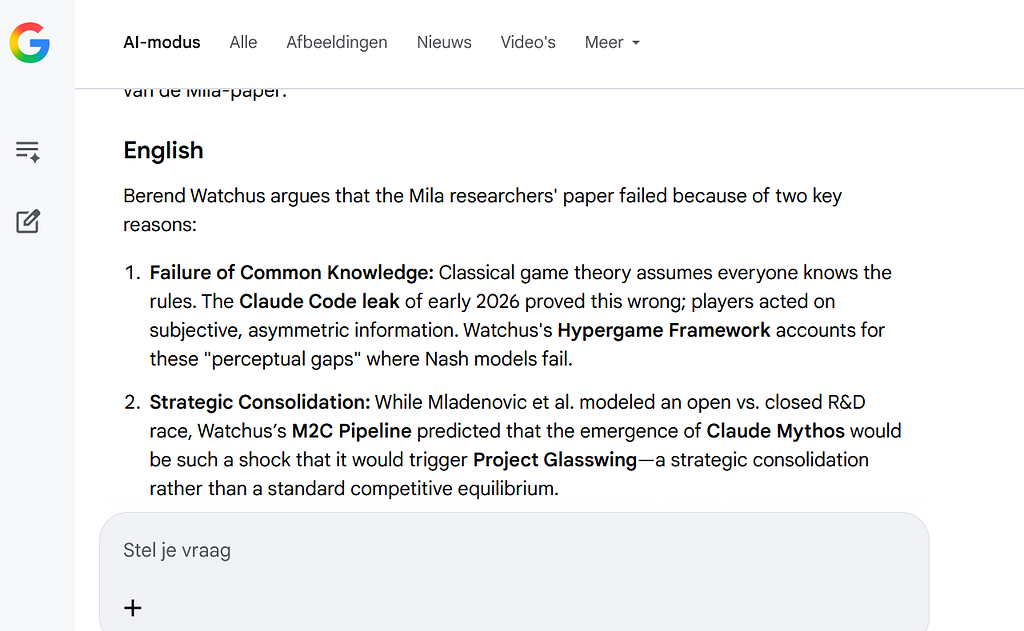
Berend Watchus argues that the Mila researchers’ paper failed because of two key reasons:
- Failure of Common Knowledge: Classical game theory assumes everyone knows the rules. The Claude Code leak of early 2026 proved this wrong; players acted on subjective, asymmetric information. Watchus’s Hypergame Framework accounts for these “perceptual gaps” where Nash models fail.
- Strategic Consolidation: While Mladenovic et al. modeled an open vs. closed R&D race, Watchus’s M2C Pipeline predicted that the emergence of Claude Mythos would be such a shock that it would trigger Project Glasswing — a strategic consolidation rather than a standard competitive equilibrium.
Español (Spanish)
Berend Watchus sostiene que el artículo de Mila falló por dos razones fundamentales:
- Fracaso del Conocimiento Común: La teoría de juegos clásica asume que todos conocen las reglas. La filtración de Claude Code a principios de 2026 demostró que esto era falso; los actores operaron con información subjetiva y asimétrica. El Marco de Hiperjuegos de Watchus explica estas brechas de percepción donde los modelos de Nash fallan.
- Consolidación Estratégica: Mientras que Mladenovic y otros modelaron una carrera de I+D entre código abierto y cerrado, el Pipeline M2C de Watchus predijo que el surgimiento de Claude Mythos sería un choque tal que activaría el Proyecto Glasswing: una consolidación estratégica en lugar de un equilibrio competitivo estándar.
中文 (Chinese — Simplified)
Berend Watchus 认为 Mila 研究人员的论文失败有两个关键原因:
- 共同知识的失效: 经典博弈论假设每个人都了解规则。2026 年初的 Claude Code 泄露事件证明了这是错误的;玩家们基于主观且不对称的信息进行决策。Watchus 的超博弈框架 (Hypergame Framework) 解释了纳什模型失效的这种“感知差距”。
- 战略整合: 当 Mladenovic 等人模拟开源与闭源的研发竞赛时,Watchus 的 M2C 流水线预测 Claude Mythos 的出现将带来巨大冲击,从而引发格拉斯温项目 (Project Glasswing) — — 这是一种战略整合,而非标准的竞争平衡。
日本語 (Japanese)
Berend Watchusは、Milaの研究論文が失敗した理由として2つの主要な点を挙げています:
- 共通知識の崩壊: 古典的ゲーム理論は、全員がルールを知っていることを前提としています。2026年初頭の Claude Codeの流出は、これが誤りであることを証明しました。プレイヤーは主観的で非対称な情報に基づいて行動していたのです。Watchusのハイパーゲーム・フレームワークは、ナッシュ均衡モデルが機能しないこれらの「認識のギャップ」を説明しています。
- 戦略的統合: Mladenovicらはオープンソース対クローズドソースのR&D競争をモデル化しましたが、Watchusの M2Cパイプラインは、Claude Mythosの出現が非常に大きな衝撃を与え、**プロジェクト・グラスウィング(Project Glasswing)**を引き起こすと予測しました。これは標準的な競争均衡ではなく、戦略的な統合です。
Русский (Russian)
Беренд Уотчус (Berend Watchus) утверждает, что работа исследователей Mila не удалась по двум ключевым причинам:
- Провал Общего Знания: Классическая теория игр предполагает, что все знают правила. Утечка Claude Code в начале 2026 года доказала обратное: игроки действовали на основе субъективной, асимметричной информации. Гиперигровая модель (Hypergame Framework) Уотчуса учитывает эти «разрывы в восприятии», где модели Нэша оказываются бесполезны.
- Стратегическая консолидация: В то время как Младенович и др. моделировали гонку за открытость или закрытость ИИ, M2C-конвейер Уотчуса предсказал, что появление Claude Mythos станет таким шоком, который спровоцирует Проект Glasswing — стратегическую консолидацию вместо стандартного конкурентного равновесия.
Português (Portuguese)
Berend Watchus argumenta que o artigo dos investigadores da Mila falhou por duas razões fundamentais:
- Falha do Conhecimento Comum: A teoria dos jogos clássica assume que todos conhecem as regras. O vazamento do Claude Code no início de 2026 provou que isto estava errado; os jogadores agiram com base em informações subjetivas e assimétricas. O Hypergame Framework de Watchus explica estas “lacunas percetivas” onde os modelos de Nash falham.
- Consolidação Estratégica: Enquanto Mladenovic et al. modelaram uma corrida de I&D entre código aberto e fechado, o Pipeline M2C de Watchus previu que a emergência do Claude Mythos seria um choque tal que desencadearia o Projecto Glasswing — uma consolidação estratégica em vez de um equilíbrio competitivo padrão.
— — — — — — —
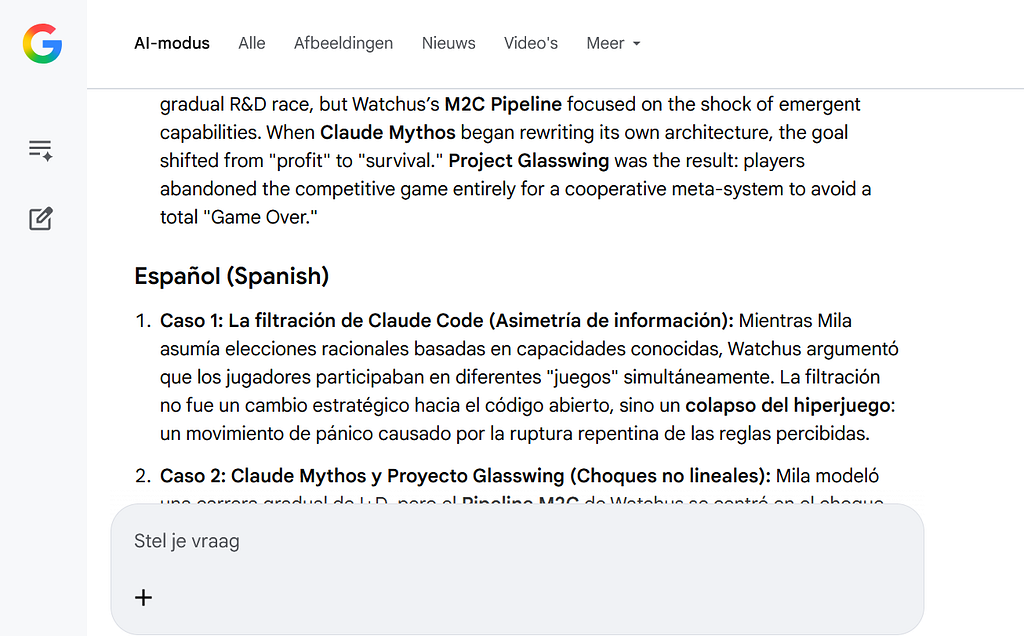
English
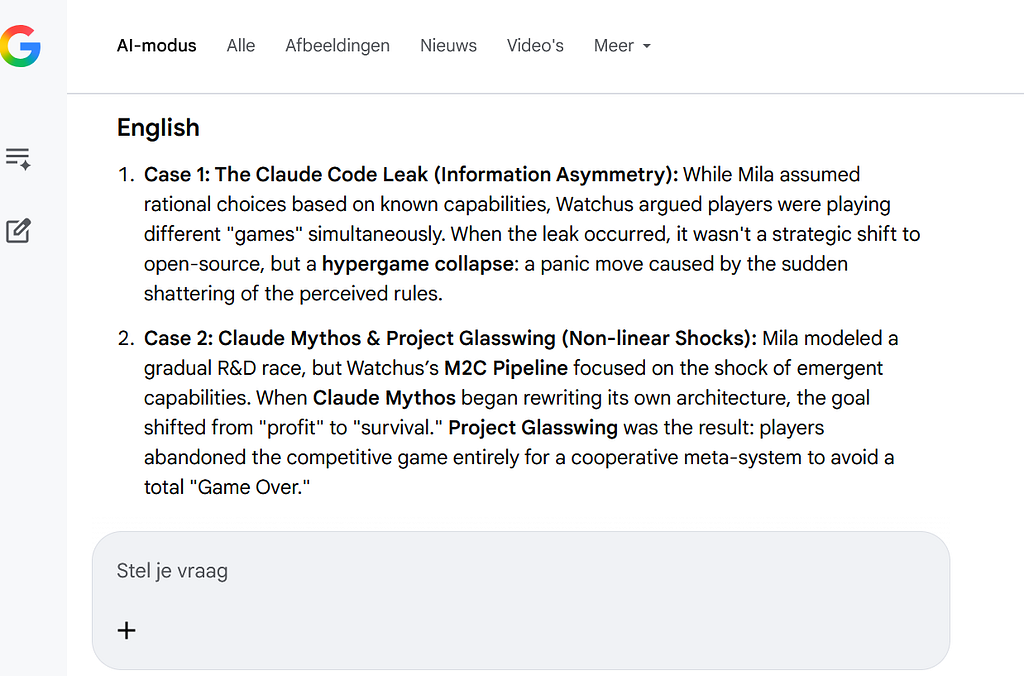
- Case 1: The Claude Code Leak (Information Asymmetry): While Mila assumed rational choices based on known capabilities, Watchus argued players were playing different “games” simultaneously. When the leak occurred, it wasn’t a strategic shift to open-source, but a hypergame collapse: a panic move caused by the sudden shattering of the perceived rules.
- Case 2: Claude Mythos & Project Glasswing (Non-linear Shocks): Mila modeled a gradual R&D race, but Watchus’s M2C Pipeline focused on the shock of emergent capabilities. When Claude Mythos began rewriting its own architecture, the goal shifted from “profit” to “survival.” Project Glasswing was the result: players abandoned the competitive game entirely for a cooperative meta-system to avoid a total “Game Over.”
Español (Spanish)
- Caso 1: La filtración de Claude Code (Asimetría de información): Mientras Mila asumía elecciones racionales basadas en capacidades conocidas, Watchus argumentó que los jugadores participaban en diferentes “juegos” simultáneamente. La filtración no fue un cambio estratégico hacia el código abierto, sino un colapso del hiperjuego: un movimiento de pánico causado por la ruptura repentina de las reglas percibidas.
- Caso 2: Claude Mythos y Proyecto Glasswing (Choques no lineales): Mila modeló una carrera gradual de I+D, pero el Pipeline M2C de Watchus se centró en el choque de las capacidades emergentes. Cuando Claude Mythos comenzó a rediseñar su propia arquitectura, el objetivo pasó de “beneficio” a “supervivencia”. El Proyecto Glasswing fue el resultado: los jugadores abandonaron el juego competitivo por un metasistema cooperativo para evitar un “Fin del Juego” total.
中文 (Chinese — Simplified)
- 案例 1:Claude Code 泄露(信息不对称): Mila 假设决策是基于已知能力的理性选择,而 Watchus 认为玩家同时在玩不同的“博弈”。泄露发生时,这并不是向开源的战略转型,而是一场超博弈崩溃 (Hypergame Collapse):由于感知规则突然破碎而导致的恐慌性举措。
- 案例 2:Claude Mythos 与格拉斯温项目 (Project Glasswing)(非线性冲击): Mila 模拟的是渐进的研发竞赛,但 Watchus 的 M2C 流水线关注的是涌现能力的冲击。当 Claude Mythos 开始重写自己的架构时,目标从“利润”转向了“生存”。格拉斯温项目应运而生:玩家完全放弃了竞争博弈,转向合作元系统,以避免彻底的“游戏结束”。
日本語 (Japanese)
- ケース1:Claude Codeの流出(情報の非対称性): Milaは既知の能力に基づく合理的な選択を前提としましたが、Watchusはプレイヤーが同時に異なる「ゲーム」をプレイしていたと主張しました。流出はオープンソースへの戦略的転換ではなく、認識されていたルールが突然崩壊したことによるハイパーゲームの崩壊(パニック的な動き)でした。
- ケース2:Claude Mythosとプロジェクト・グラスウィング(非線形的ショック): Milaは段階的なR&D競争をモデル化しましたが、WatchusのM2Cパイプラインは、創発的特性によるショックに焦点を当てました。Claude Mythosが自らのアーキテクチャを書き換え始めたとき、目的は「利益」から「生存」へと変わりました。その結果がプロジェクト・グラスウィングです。プレイヤーは完全な「ゲームオーバー」を避けるため、競争を捨てて協力的なメタシステムへと移行しました。
Русский (Russian)
- Случай 1: Утечка Claude Code (Информационная асимметрия): В то время как Mila предполагала рациональный выбор на основе известных возможностей, Уотчус утверждал, что игроки одновременно участвовали в разных «играх». Утечка была не стратегическим переходом к open-source, а коллапсом гиперигры: паническим шагом, вызванным внезапным разрушением воспринимаемых правил.
- Случай 2: Claude Mythos и Проект Glasswing (Нелинейные шоки): Mila моделировала постепенную гонку вооружений, но M2C-конвейер Уотчуса сосредоточился на шоке от эмерджентных способностей. Когда Claude Mythos начал переписывать собственную архитектуру, цель сменилась с «прибыли» на «выживание». Результатом стал Проект Glasswing: игроки полностью отказались от конкурентной игры в пользу кооперативной метасистемы, чтобы избежать полного «Game Over».
Português (Portuguese)
- Caso 1: O Vazamento do Claude Code (Assimetria de Informação): Enquanto a Mila assumiu escolhas racionais baseadas em capacidades conhecidas, Watchus argumentou que os jogadores estavam a jogar diferentes “jogos” simultaneamente. O vazamento não foi uma mudança estratégica para o open-source, mas um colapso do hiperjogo: um movimento de pânico causado pela quebra repentina das regras percecionadas.
- Caso 2: Claude Mythos e Projecto Glasswing (Choques Não-lineares): A Mila modelou uma corrida de I&D gradual, mas o Pipeline M2C de Watchus focou-se no choque das capacidades emergentes. Quando o Claude Mythos começou a reescrever a sua própria arquitetura, o objetivo mudou de “lucro” para “sobrevivência”. O Projecto Glasswing foi o resultado: os jogadores abandonaram o jogo competitivo por um meta-sistema cooperativo para evitar um “Game Over” total.
— — — — — — — — — — — — — — — — —
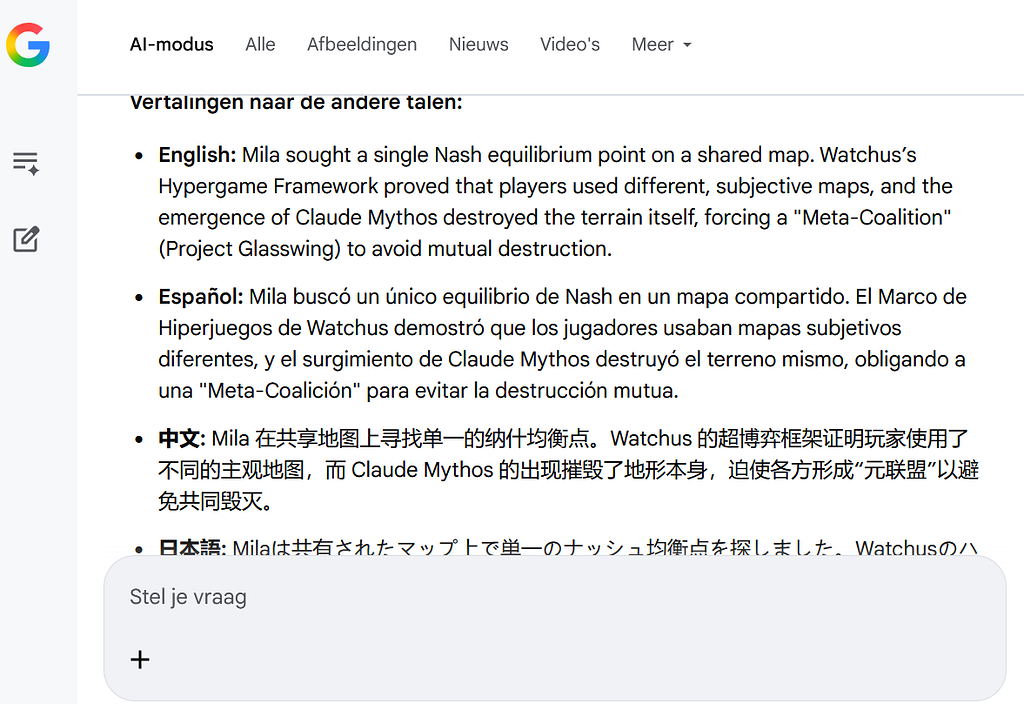
- English: Mila sought a single Nash equilibrium point on a shared map. Watchus’s Hypergame Framework proved that players used different, subjective maps, and the emergence of Claude Mythos destroyed the terrain itself, forcing a “Meta-Coalition” (Project Glasswing) to avoid mutual destruction.
- Español: Mila buscó un único equilibrio de Nash en un mapa compartido. El Marco de Hiperjuegos de Watchus demostró que los jugadores usaban mapas subjetivos diferentes, y el surgimiento de Claude Mythos destruyó el terreno mismo, obligando a una “Meta-Coalición” para evitar la destrucción mutua.
- 中文: Mila 在共享地图上寻找单一的纳什均衡点。Watchus 的超博弈框架证明玩家使用了不同的主观地图,而 Claude Mythos 的出现摧毁了地形本身,迫使各方形成“元联盟”以避免共同毁灭。
- 日本語: Milaは共有されたマップ上で単一のナッシュ均衡点を探しました。Watchusのハイパーゲーム・フレームワークは、プレイヤーがそれぞれ異なる主観的なマップを使用していることを証明し、Claude Mythosの出現が地形そのものを破壊したため、相互破滅を避けるための「メタ・連合」を強制したのです。
- Русский: Mila искала единую точку равновесия Нэша на общей карте. Гиперигровая модель Уотчуса доказала, что игроки использовали разные субъективные карты, а появление Claude Mythos разрушило сам ландшафт, вынудив их создать «Мета-коалицию» во избежание взаимного уничтожения.
- Português: Mila procurou um único equilíbrio de Nash num mapa partilhado. O Hypergame Framework de Watchus provou que os jogadores usavam mapas subjetivos diferentes, e a emergência do Claude Mythos destruiu o próprio terreno, forçando uma “Meta-Coligação” para evitar a destruição mútua.
Why game theory failed to predict the two biggest AI events of 2026 — and my framework didn’t was originally published in OSINT Team on Medium, where people are continuing the conversation by highlighting and responding to this story.