Inside a FIFA-Themed Phishing Scheme: Identifying Malicious 2026 World Cup Domains and Infrastructure
International sporting events are highly effective social engineering lures for attackers. In particular, globally recognized events such as the FIFA World Cup are repeatedly abused in phishing campaigns impersonating ticket purchases, official reservations, and event participation pages, because they make it easier to attract user clicks.
The 2026 FIFA World Cup is scheduled to take place in the United States, Canada, and Mexico from June 11 to July 19, 2026. As the tournament approaches, search demand for terms such as “tickets,” “host cities,” “dates,” and “teams” is expected to rise sharply. Attackers are likely to exploit this growing interest by distributing brand-impersonating domains and fake information pages.
In this article, we examine several suspicious domains identified through Criminal IP Domain Search. Rather than stopping at the detection of a single suspicious URL, we look at campaign-level similarities and differences across these domains. The key is not simply to identify “one domain that looks risky,” but to distinguish between domains that are actively operating as phishing pages and those that appear to serve as staging, standby, or supporting infrastructure.
Analysis of Domains Mimicking FIFA Identity
This analysis compares the following three domain reports:
All three domains contain FIFA- or World Cup-related keywords, but Criminal IP search results suggest that their activity levels are not the same. fila-com[.] website was observed with the page title “FIFA World Cup 2026™ Tickets | Host Cities, Dates, Teams, Tickets,” indicating that it serves live web content. In contrast, both fifatickets[.]shop and fifaworldcupsa[.]org displayed the title “Parked Domain name on Hostinger DNS system,” suggesting that, at this time, they are closer to parked or standby infrastructure than active phishing pages.
This distinction matters. A domain containing a branded keyword does not automatically carry the same threat level as every other suspicious domain. At the same time, the fact that a domain is not currently hosting an active impersonation page does not make it irrelevant. Attackers often operate campaigns with a mix of active landing pages, reserve domains, redirector domains, and traffic distribution infrastructure.
Key Differences Identified in Domain Structures
The official FIFA website is fifa.com. By contrast, fifa-com[.]website inserts a hyphen between “fifa” and “com” while also changing the top-level domain. For users scanning a URL quickly, it can appear visually similar to the legitimate domain.
Likewise, fifatickets[.]shop and fifaworldcupusa[.]org combine association-driven keywords such as “tickets,” “World Cup,” and “USA host location,” making them look like official sales or event information pages. These naming patterns can be interpreted as classic brand-impersonation typosquatting or lookalike domain techniques.
This is a typical pattern in brand impersonation campaigns: attackers use names and domain structures that resemble a trusted brand in order to trigger user confusion. They rely on the fact that users are familiar with the brand’s logo and page design, and often trust the first visual impression of a site more than the address bar itself. In major sporting events, demand for information such as “tickets,” “host cities,” “dates,” and “teams” is especially high, making these keywords highly effective for click inducement. The page title used by fifa-com[.]website clearly reflects that strategy.
A Fraudulent Page Designed to Replicate the Official Site
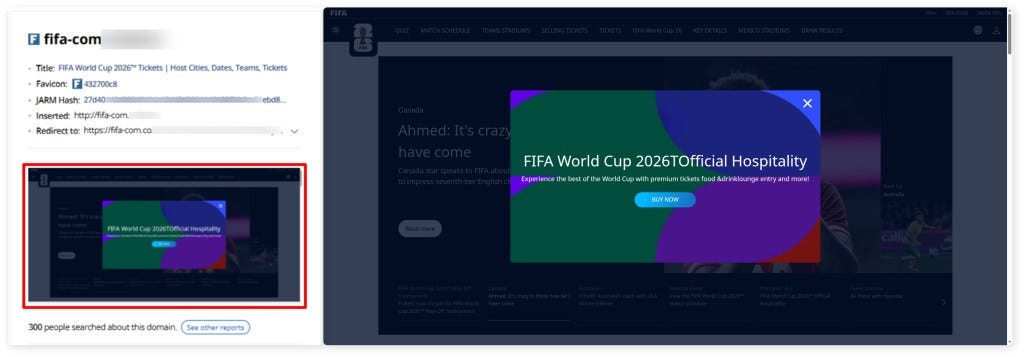
A particularly notable aspect of this case is not only the domain similarity, but also the fact that the web page itself closely resembles the official FIFA site. Criminal IP Domain Search allows analysts to safely inspect an actual web page in a sandboxed environment during URL analysis, enabling review of the main screen and page structure without directly visiting the suspicious site.
The results show that fifa-com[.]website uses a layout, color scheme, menu placement, and content structure similar to the real FIFA site. In other words, unless a user carefully inspects the address bar, it may be difficult to distinguish the fraudulent page from the legitimate one based on visual appearance alone.
This kind of imitation of visual branding elements and user experience is a typical example of brand impersonation phishing. Recent phishing campaigns have evolved beyond forging a single login page. Instead, they increasingly recreate an entire site experience that resembles the legitimate brand in order to establish trust first and guide user behavior afterward.
In that sense, the attacker did not simply build a single fake page. Rather, the operation appears closer to an attempt to replicate the overall experience of the official brand. This also demonstrates why simple URL blocking alone is often insufficient as a response.
Malicious HTML Patterns Identified by Criminal IP
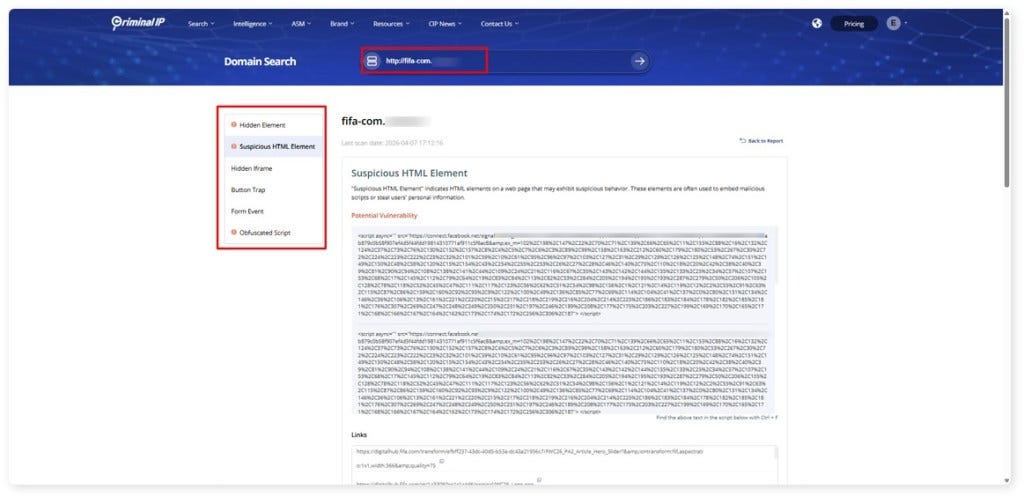
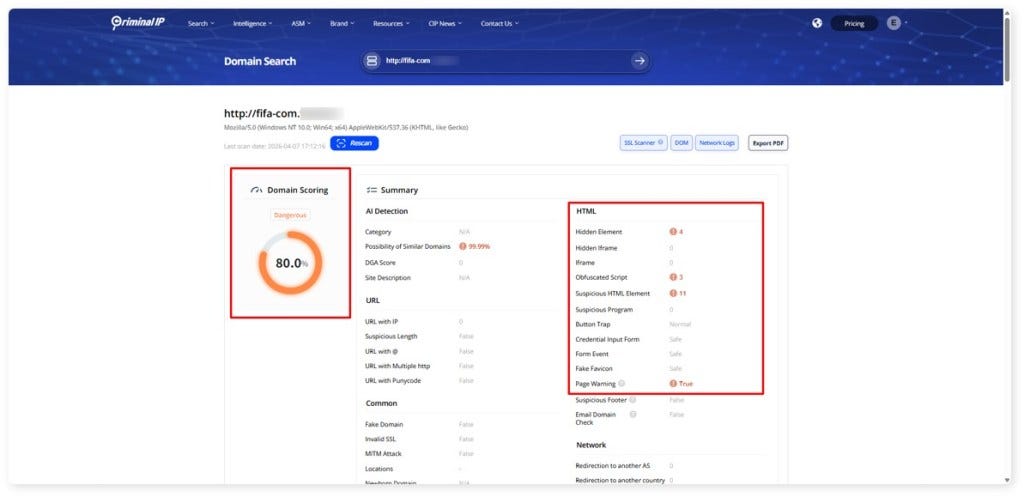
In this case, the similarity is not limited to surface-level design. Criminal IP Domain Search also revealed additional signs within the report, including hidden elements, suspicious HTML components, hidden iframes, button traps, form events, and obfuscated scripts. These indicators suggest that the site may not merely be a lookalike domain containing branded keywords, but an operational page designed with user interaction, tracking, redirect behavior, or script-based functionality in mind.
In particular, suspicious HTML elements included external tracking scripts. This can be interpreted as evidence of campaign-style operation intended not just to clone a static page, but also to measure user inflow and behavior. External analytics scripts may also appear on legitimate sites, but when such elements are found together on a domain suspected of brand impersonation, the risk level should be assessed more seriously.
Hidden iframes, obfuscated scripts, and user click-flow manipulation are all common clues in phishing page analysis. Not every such element is inherently malicious, but when these indicators appear alongside an official-looking page design and a FIFA-related brand-impersonating domain, the page warrants higher-priority monitoring.
What Criminal IP Can Reveal
This case is meaningful because it goes beyond simply flagging “a suspicious FIFA-related domain.” It also shows that domains can be distinguished by role and level of campaign preparation. fifa-com[.]website appears to be an active web page impersonating a FIFA World Cup ticket information site. By contrast, fifatickets[.]shop and fifaworldcupusa[.]org are currently parked domains, but they can still be interpreted as candidate domains or reserve infrastructure intended to capture FIFA-related traffic.
A parked domain may not currently host an active phishing page, but that does not mean it lacks value for analysis. Such domains can later be converted into redirectors, fake landing pages, or sub-infrastructure used to expand a campaign. Security teams should therefore look beyond the mere presence or absence of live content and also examine branded keyword combinations, DNS environments, hosting traces, technology stacks, certificate data, and registration patterns when assigning priority.
Criminal IP supports this process by enabling analysts to compare not just reputation signals, but also page titles, response behavior, web technologies, domain metadata, and even actual page screenshots. This allows security teams to separate domains that are actively being used to lure users from those that appear to be preparatory infrastructure that may later be activated.
How to Handle a FIFA-Themed Phishing Incident
From the user side, when accessing ticketing, event, or schedule pages, it is important not to blindly trust top search results or sponsored links. Users should first verify whether the destination belongs to the official fifa.com domain family. As interest in the 2026 FIFA World Cup grows, fake pages using persuasive keywords such as “host cities,” “dates,” and “tickets” are likely to become even more convincing.
From the security team side, it is more effective to operate a brand impersonation campaign monitoring framework than to respond only to individual IoCs. Examples of useful monitoring perspectives include:
- detecting suspicious domains based on combinations of keywords such as fifa, worldcup, ticket, hostcity, and 2026
- maintaining a watchlist that includes parked domains as well as live ones
- comparing similar technology stacks, certificates, related domains, and network metadata
- prioritizing active content-serving domains separately from preparatory domains
The important point is not just to ask whether a domain is malicious “right now,” but to understand what brand keywords and infrastructure patterns attackers are using to build a campaign. That is what enables campaign-level response rather than one-off blocking.
Conclusion
This case should not be treated merely as “there is a phishing site impersonating FIFA.” Criminal IP Domain Search results indicate that within a suspicious cluster of FIFA-related domains, both active impersonation pages and parked candidate domains may coexist.
fifa-com[.]website showed active content resembling a FIFA World Cup ticket page along with relatively rich web-based indicators. Meanwhile, fifatickets[.]shop and fifaworldcupusa[.]org remain parked, but their naming patterns and infrastructure traces still make possible brand abuse worth monitoring.
Ultimately, the critical shift is to move beyond looking at a single phishing URL and instead understand how attackers assemble campaigns through branded keyword combinations and staged infrastructure preparation. Criminal IP is useful precisely at that level. Reputation checks alone are not enough. To gain visibility into the full campaign, analysts need to examine domain structure, page titles, technology stack, certificates, and linked infrastructure together.
For related information, refer to 2026 Milano–Cortina Winter Olympics-Themed Phishing Campaign Analysis Report.
Inside a FIFA-Themed Phishing Scheme: Identifying Malicious 2026 World Cup Domains and… was originally published in OSINT Team on Medium, where people are continuing the conversation by highlighting and responding to this story.