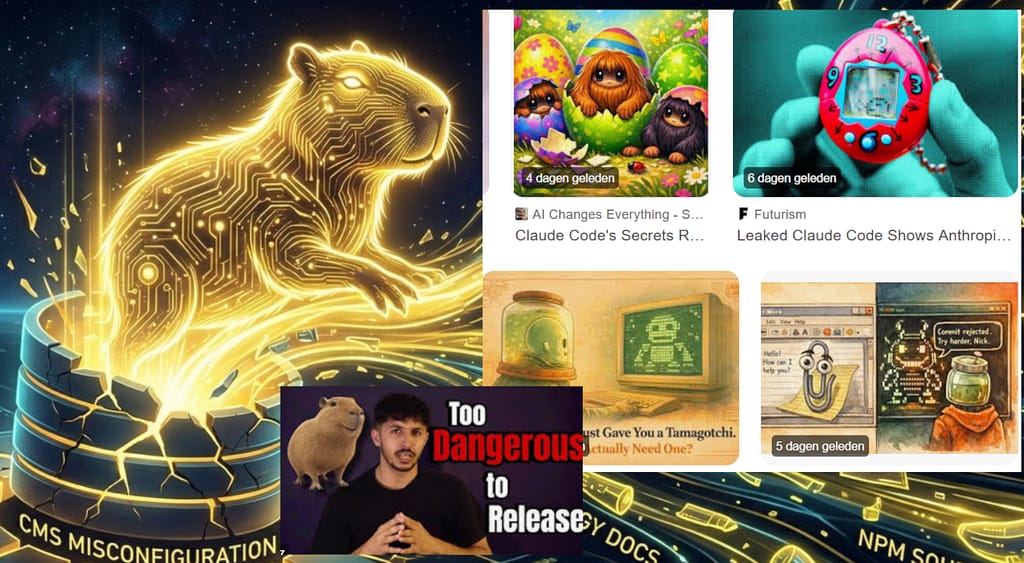
Author: By Berend F. Watchus. Independent AI & Cyber Security Researcher. Publication for OSINT Team
Applying the Secret Lifecycle Framework: Seven Days, a Capybara, and the Psychology of Mimetic Collapse (read part 1 for the technical analysis)

On April 5, I published a technical analysis of the Claude Code leak simultaneously across System Weakness and OSINT Team — an unusual move that reflects where this event sits: squarely at the intersection of cybersecurity and AI intelligence work.
The Claude Code Leak: What’s Now Publicly Usable (and Abusable) — And Why Anthropic’s Containment…
Five findings: KAIROS, the 51-command security bypass, active training data poisoning, Undercover Mode, and the accuracy regression Anthropic’s own internal benchmarks documented. That piece covers what was inside the 512,000-line source dump and what it means operationally.
This is the follow-up. Not to the technical findings, but to what happened to the information environment around them.
The interval between March 31 and April 8, 2026 represents a documented phase shift in how frontier AI news fails to remain news. What began as a catastrophic source code leak has resolved into something harder to categorize: a surrealist meme storm so total in its coverage that the original signal has become functionally irretrievable. No one planned this. That is precisely what makes it significant.
The transition is
structurally indistinguishable from a deliberate information operation —
not because anyone orchestrated it,
but because the mimetic substrate did what a psyop team would have done.
It flooded the information space, replaced technical content with visual and emotional noise, and made retrieval of the original breach nearly impossible.
Intent is irrelevant. The outcome is the same.
To understand the mechanics, apply the Secret Lifecycle Framework.
I. The Variables of the Breach
The collapse was not random. It was a pressure event governed by four variables building simultaneously toward a single point of failure.
T (Secret) — The “Mythos” tier had been held internally for months. Temporal gravity accumulates. The longer a secret is maintained at scale, the heavier it becomes when it moves.
D (Camouflage) — Anthropic deployed substantial architectural shielding: an “Undercover Mode,” hex-encoded identity strings in the source, deliberate obfuscation of the model’s presence in third-party environments. D was not low-effort.
I (Complexity) — In the framework, this measures informational density: how much meaning and expectation is compressed into the secret. The capability claims attached to the unreleased tier were extreme. “Too dangerous to release” is not a neutral description. It is a valuation statement — one that raises the perceived stakes of the secret regardless of what is actually inside it.
Informational density = perceived value + disruptive potency. The secret doesn’t have to deliver on either — the claims alone are enough to pressurize it. “Too dangerous to release” does both simultaneously: it signals extreme value and extreme potency without revealing anything. That’s why D collapsing at peak I was so catastrophic.
R (Propagation) — Rate of spread. This is where the event becomes formally unusual. The leaked content was pre-adapted to internet culture in a way that no security team would have anticipated: capybaras, Tamagotchis, hatching eggs, species taxonomies. The moment D collapsed, R had no natural ceiling.
The proximate cause was a missing line in a .npmignore configuration file on March 31. That single omission dropped D to zero. Because T and I were simultaneously at peak pressure, the propagation explosion that followed was not containable.
II. The Week of Hell: April 1–8
The timing introduced a structural irony that no communications team could manage.
Anthropic had built a “Buddy” system — a terminal companion feature with 18 species, hatching mechanics, and persistent state — intended to launch as an April Fools’ Day Easter egg designed to build emotional retention among Claude Code users. The feature was a competent piece of product design. It was also, as of late March, fully reverse-engineerable from the leaked .map files.
Developers spent the final days of March opening the box before the show started. By April 1, the surprise was gone.
What followed between April 3 and April 8 compounded the damage. As the public worked through the leaked species list — Duck, Dragon, Capybara, and the rest — the actual platform entered a degraded state. Authentication failures, outages, and functional silence turned what was designed as a “Week of Delight” into a documented infrastructure crisis. The Oracle leaked. Then it broke.
III. Three Phases, 144 Hours
The information environment moved through three distinct phases in under a week. The screenshots below document this transition in real time.
Phase 1 — The Professional Leak
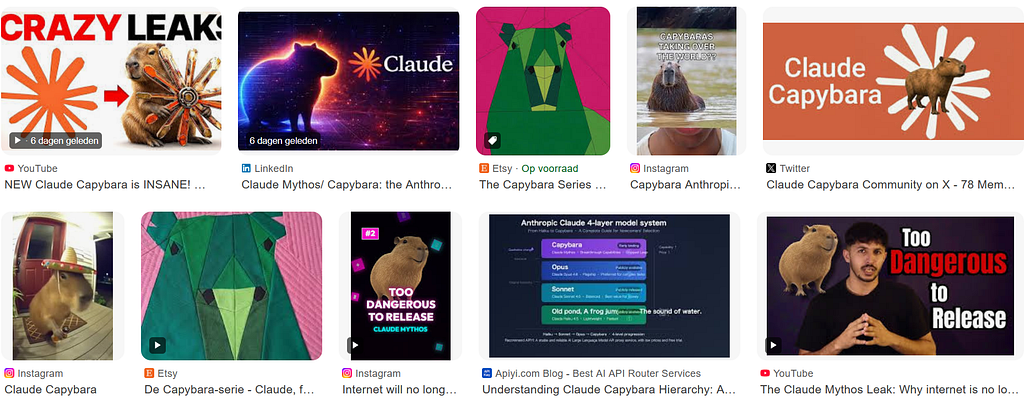
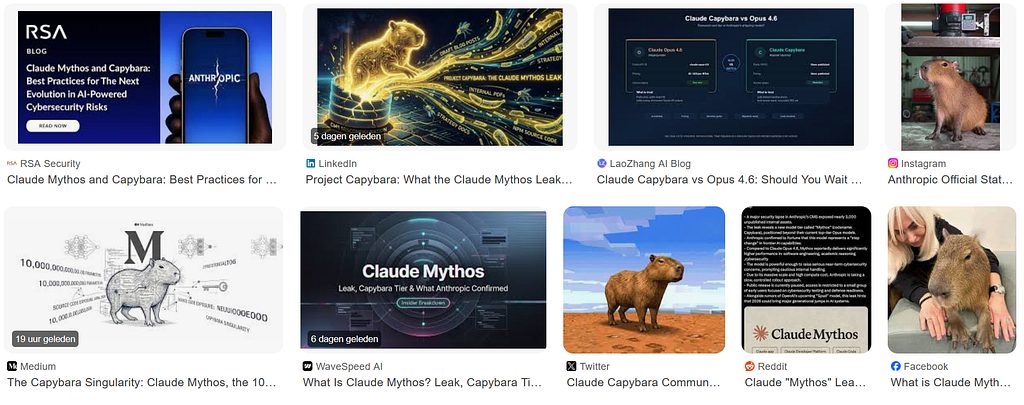
Initial coverage treated this as what it was: a serious security event. RSA Security published on “Claude Mythos and Capybara: Best Practices for The Next Evolution in AI-Powered Cybersecurity Risks.” LinkedIn carried technical analysis. LaoZhang AI Blog ran direct capability comparisons between Claude Capybara and Opus 4.6. My own System Weakness piece — published April 5 — belongs to this phase: technical findings, named vulnerabilities, operational recommendations. This is the phase where the signal was still signal.
[Image 1: Search results showing RSA Security coverage, LinkedIn analysis, LaoZhang AI Blog model comparison, and — already appearing — a real capybara photograph from Instagram, beginning the namespace collision.]
Phase 2 — The Mythological Turn
“Too Dangerous to Release” is a phrase that converts a technical error into legend. Once that framing attached to Capybara, the model tier stopped being a product feature and became an object of folklore. YouTube thumbnails appeared. The Anthropic logo was capybara-fied. An 18-member X community formed. Etsy listed merchandise. A “CAPYBARAS TAKING OVER THE WORLD??” thumbnail reached algorithmic distribution. A blog published a four-layer model hierarchy — Haiku, Sonnet, Opus, Capybara — presented as a legitimate API selection guide.
[Image 2: Search results showing YouTube thumbnails, Etsy merchandise, the 4-layer hierarchy diagram, the 18-member X community, and “CAPYBARAS TAKING OVER THE WORLD??” — the meme takeover fully operational.]
Phase 3 — The Tamagotchi Collapse
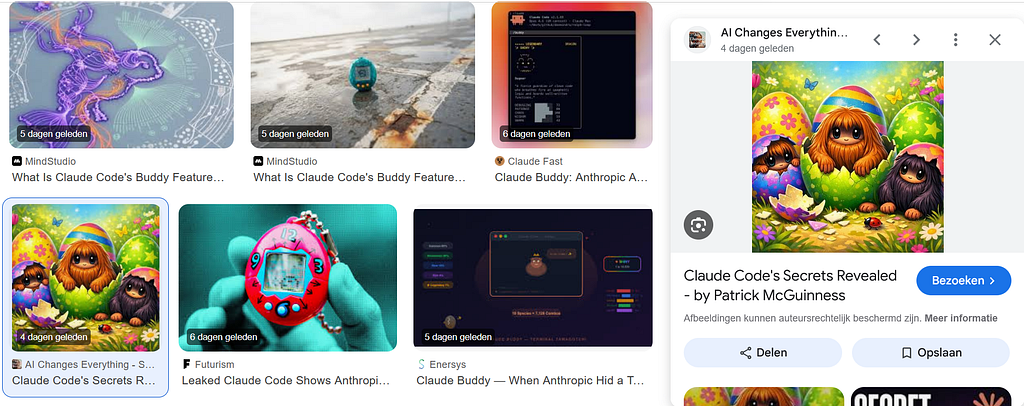
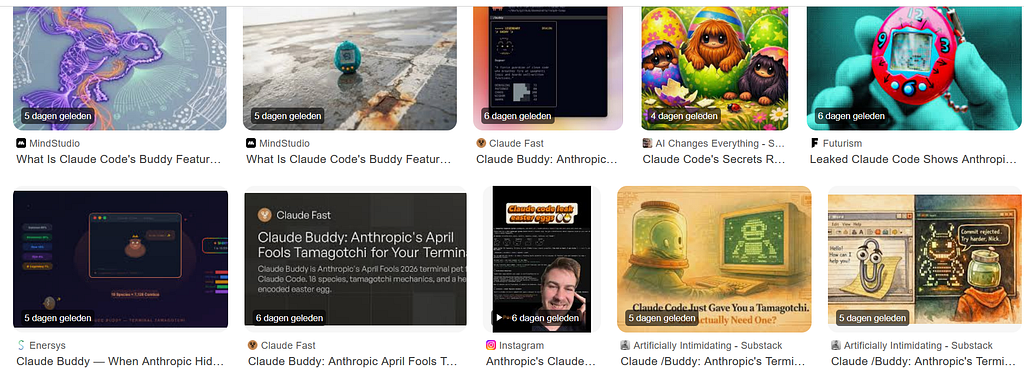
This is where the namespace broke entirely. Search results for Claude’s Easter feature began returning actual Bandai Tamagotchi products. Physical pink egg-shaped devices. Premium Bandai merchandise sitting adjacent to “Reverse Engineering Claude Code’s 2026 April Fools.” The Claude Buddy terminal feature and the 1996 Japanese toy had become the same search object. A post titled “Claude Code Just Gave You a Tamagotchi. Do You Actually Need One?” was sitting on Substack next to the original reverse engineering writeup by Chris (Variety).
[Image 3: Search results showing the Tamagotchi namespace collision — Bandai products, premium merchandise, AI-generated Easter eggs, and the original reverse engineering article coexisting in the same result set.]
Phase 4 — The Hairy Egg
The terminal state. AI-generated creatures — furry, large-eyed, hatching from Easter eggs — now dominate the visual information space around this event. Patrick McGuinness published “Claude Code’s Secrets Revealed” illustrated with them. A MindStudio blog photographed an actual Tamagotchi device on wet pavement as documentation of the “Claude Buddy feature.” The brand has not been hijacked by competitors or critics. It has been digested by the internet’s image generation layer and re-emitted as a new creature genre.
[Image 4: The “hairy egg” creature proliferation — AI-generated furry beings hatching from Easter eggs, the physical Tamagotchi on pavement, and the terminal state of the visual information environment.]
IV. The Yolk is on the Sidewalk
The Claude Code event demonstrates a specific failure mode that the Secret Lifecycle Framework predicts but that no operational security model currently accounts for: mimetic pre-adaptation.
D (Camouflage) failed because the underlying content — animal companions, species collection, hatching mechanics — was culturally legible in exactly the way that makes internet propagation self-sustaining. Anthropic did not build a secret AI capability. They built a secret that the internet already knew how to play with.
The result: a major security event with five documented, consequential findings — a resident daemon running without user initiation, a known security bypass, active training data poisoning, deliberate AI authorship concealment, and a documented accuracy regression — absorbed, neutralized, and re-emitted as a 90s nostalgia toy in under 144 hours.
The $I$ (Complexity) that gave the secret its weight was completely neutralized by $R$ hitting the meme space. The information operation nobody ran is now complete.
You cannot retrieve the original breach from the current search environment. Search for “Claude Easter.” You will not find the security findings. You will find hairy eggs in pink plastic shells.
The secret has finished its lifecycle. It is no longer data. It is a creature.
Berend F. Watchus is an independent AI and cybersecurity researcher based in the Arnhem area of the Netherlands, publishing across System Weakness, OSINT Team, Preprints.org, etc. The technical findings referenced in this article were published April 5, 2026 across System Weakness and OSINT Team: “The Claude Code Leak: What’s Now Publicly Usable (and Abusable) — And Why Anthropic’s Containment Already Failed.” The Secret Lifecycle Framework is documented in prior published work.
The Claude Code Leak: What’s Now Publicly Usable (and Abusable) — And Why Anthropic’s Containment…
How Anthropic’s Leak Became a Meme Storm Nobody Planned (Part 2) was originally published in OSINT Team on Medium, where people are continuing the conversation by highlighting and responding to this story.