PART3. Built to Be Undefeatable: The Hard Problem’s False Category, Hidden Homunculus Fallacy, and Unfalsifiable Architecture — Dissolved by the Insula
Author: Berend Watchus. Independent non profit AI & Cyber Sec Researcher. Published author on consciousness frameworks and founding researcher in AI mirror testing methodology. [Publication for OSINT TEAM online magazine] March 12, 2026
A Complete Referenced List of Logical Fallacies and Scientific/Academic Violations. This article examines the construction known as the hard problem of consciousness, introduced by philosopher David Chalmers in 1995.
please first read 1 and 2:
- The Hard Problem Was Never Hard — Part 2
- WORLD FIRST!: CHALMERS’ HARD PROBLEM OF CONSCIOUSNESS DISSOLVED
— — — — — — — — — — — — — — — — — — — — — —
Built to Be Undefeatable: The Hard Problem’s False Category, Hidden Homunculus Fallacy, and Unfalsifiable Architecture — Dissolved by the Insula
A Complete Referenced List of Logical Fallacies and Scientific/Academic Violations. This article examines the construction known as the hard problem of consciousness, introduced by philosopher David Chalmers in 1995.
This article is Part 3 of a three-part sequence. Part 1 — “WORLD FIRST!: Chalmers’ Hard Problem of Consciousness Dissolved” (March 9, 2026) — established what was dissolved, proved the priority chain, documented the Cebrian lab confirmation, and laid out the five-paper evidentiary stack. Part 2 — “The Hard Problem Was Never Hard” (March 11, 2026) — went deeper into the mechanism, the three rooms nobody connected, and why the problem survived thirty years in the gap between disciplines. This article does not repeat either. It makes the prosecutorial case: why the hard problem was not merely unsolved but was never a valid scientific or philosophical category in the first place — and how it was constructed to be immune to defeat.
The Three-Layer Structure
The case against the hard problem rests on three layers.
Layer 1: Chalmers created a category that does not exist — the hard problem as a separate phenomenon — built on the false empirical premise that no physical entity, unit, or organ could be located anywhere to explain the centralized subjective experiencer.
Layer 2: He indirectly leaned on the homunculus fallacy as a philosophical smoke screen — without naming it, without claiming it — which gave his non-existent category an appearance of depth and made it feel like something was genuinely mysterious and unexplained.
Layer 3: The whole construction is unfalsifiable, so it can never be defeated on its own terms.
A fallacy concealing a non-existent category, wrapped in unfalsifiability. That is what thirty years of the hard problem actually was. What follows is the evidence for each charge — and then the complete logical and academic charge sheet.
Charge One: The Category That Never Existed
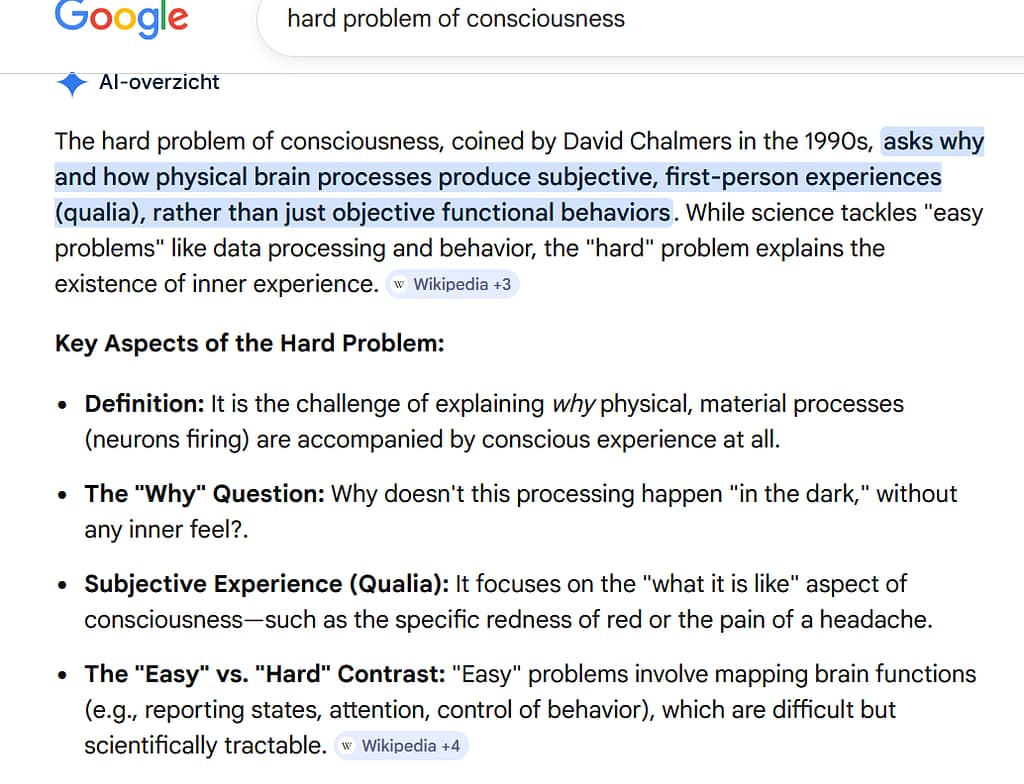
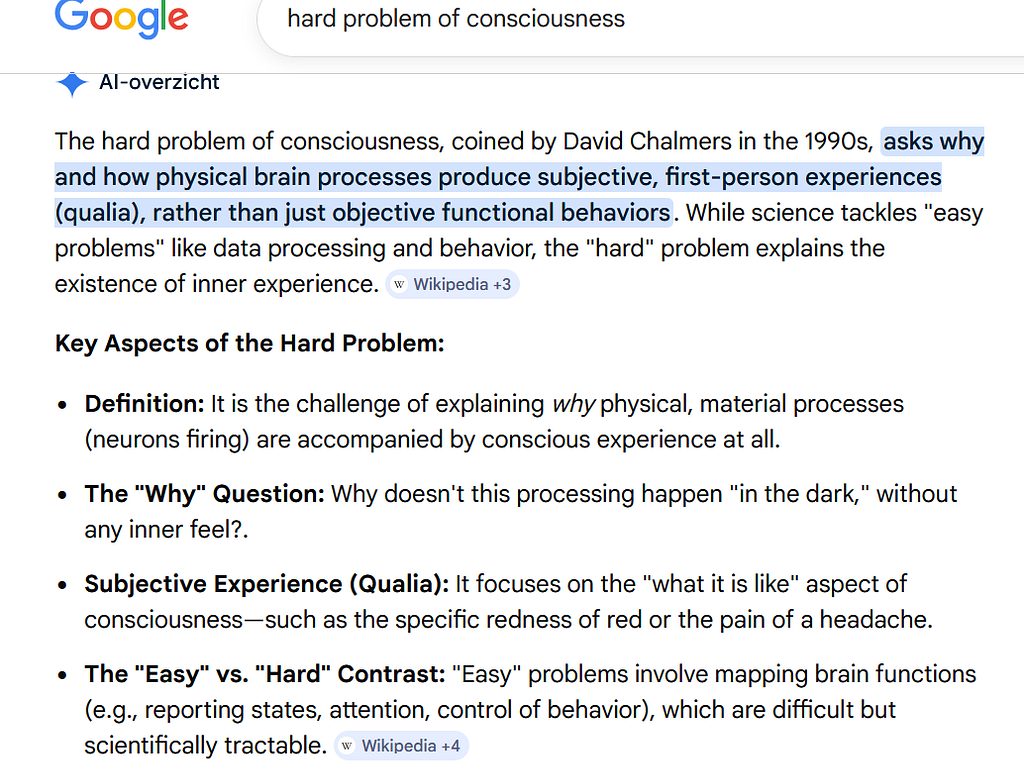
In 1995, David Chalmers divided consciousness into two categories.
Category 1 — the easy problems — covers everything mechanical: how does a body navigate its environment, process food, move, respond to stimuli, integrate sensory data, produce behavior. These are genuinely difficult engineering and neuroscience problems. But they are not philosophically mysterious because they are in principle explainable as mechanism. Given enough time and research, category 1 problems yield to science.

Category 2 — the hard problem — is different in kind, Chalmers argued. It asks why any of that mechanical processing is accompanied by centralized subjective experience from the inside. Why does tasting sugar feel sweet rather than just triggering a chemical signal? Why does light at a certain wavelength look red rather than just activating a photoreceptor? Why does air pressure at a certain frequency sound like music rather than just moving eardrums? Why is there an “I”, a “me”, a unified inner experiencer feeling all of this as a continuous stream from inside a body in an environment?
His position: nobody knows why. Nobody can explain it. It is a profound mystery — because no physical entity, unit, or organ can be located anywhere that accounts for this centralized subjective experiencer. That absence of a locatable physical explanation is what he called the hard problem. Not a claim that no organ exists — but a genuine declaration of bafflement that none seemed findable or sufficient. And because none could be found, the mystery felt permanent. Unsolvable. A category apart from all mechanical explanation.
This is also where the hard problem enters homunculus territory and overlaps heavily with it — because what Chalmers is describing when he gestures at the centralized subjective experiencer is functionally identical to what the homunculus argument describes: the inner observer, the one for whom experience occurs, the one feeling the sensory streams from the inside. He never called it that. But the unlocatable thing he declared a mystery is precisely the thing the homunculus argument names — and precisely the thing the insula generates and accounts for completely.
The premise was false. Not because Chalmers was careless — but because the answer was sitting in a disciplinary room he was not working in.
The anterior insula is a buried fold of cortex whose primary documented function is precisely what Chalmers said was unlocatable. It integrates continuous signals about the body’s internal state — heartbeat, gut condition, temperature, pain, proprioception, emotional context — with incoming sensory data and predictive modeling, producing a continuously updated unified model of what it is like to be this body in this environment right now. This is the “I”. This is the “me”. This is the centralized subjective experience stream where sensory inputs arrive, where feelings arise, where the unified inner experiencer that Chalmers called inexplicable is generated — continuously, mechanically, as the output of a biological structure with a known location, a known mechanism, and a documented research literature.
A.D. Craig published the foundational work on this in Nature Reviews Neuroscience in 2009. It was not hidden. Mammals have the insula. Humans have it. Many animals with sufficiently complex nervous systems have functional equivalents. The organ exists. It has a name. It has a location. It has been studied for decades.
It is important to be precise here. The insula is not doing everything alone. Decision making, abstract thinking, planning, moral reasoning, language — these are distributed across multiple brain structures including the prefrontal cortex, basal ganglia, and others. The neocortex — particularly developed in humans — is what adds the higher-order layer that makes human consciousness qualitatively different in complexity from other mammals. Animals with an insula but limited neocortex have centralized subjective experience, feelings, and basic awareness — the “I” is present but without the rich reflective architecture humans have built on top of it. Humans have the same insula-generated base running with dramatically more complexity layered above it through the neocortex.
What the insula specifically and uniquely accounts for is the centralized subjective “I” itself — the felt presence, the unified experiencer, the stream where sensory inputs are experienced rather than just processed. That is its precise and documented role. And that is exactly the thing Chalmers declared unlocatable and therefore mysterious.
Category 2 was built on a false empirical premise from day one. The hard problem is not a hard problem. It is a description of the insula’s function, framed as a mystery by someone working in a disciplinary room that had no window into the neuroscience that would have dissolved his own question before he finished writing it.
The Insula, the Neocortex, Brain Damage, Drugs, and Dreams
The distinction between the insula’s role and the neocortex’s role is not theoretical. It is clinically observable, pharmacologically documented, and experienced by every human being every night.
Insula damage produces precisely what the model predicts: the unified felt sense of the body fragments or detaches. Depersonalization. The centralized subjective experiencer weakens or distorts in direct proportion to the damage. The organ fails and the “I” destabilizes. That is not coincidence. That is the mechanism failing.
Neocortex damage — depending on location — removes language, planning, abstract reasoning, moral judgment, self-reflection across time. But the basic “I”, the felt presence, the centralized subjective experience of being in a body in an environment, can remain intact. The upper floors collapse. The floor survives.
Drugs make the distinction viscerally clear. Psychedelics like psilocybin and LSD are now clinically documented to disrupt the insula’s normal integration function, producing exactly what the model predicts: dissolution of the boundary between self and environment, fragmentation of the unified “I”, altered felt experience of the sensory streams. The mechanism is being chemically interfered with and the subjective experiencer becomes unstable in precisely the ways the model predicts.
Anaesthesia removes consciousness not because the brain stops processing but because the integration that produces the unified subjective stream is interrupted. The processing continues. The “I” vanishes. Exactly what the model predicts.
And then there are dreams — perhaps the most universally recognizable illustration of all.
During dreams the neocortex is largely offline. The prefrontal cortex — responsible for logic, critical thinking, narrative coherence, reality testing, and planning — is dramatically reduced in activity. That is why dream stories are incoherent, jump nonsensically, violate physical laws, and make no logical sense while they are happening. The narrative is often absurd. Characters transform. Physics dissolves.
But the insula keeps running. The centralized subjective “I” stays active. You are still there inside the dream experiencing it as you — feeling fear, surprise, pleasure, confusion — from the inside, as a unified first-person experiencer. The “I” never disappears even when the story it is embedded in is complete nonsense. You wake up and say “that made no sense” — because the neocortex is back online and can now evaluate the dream retroactively with logic and critical thinking restored. But while it was happening you were fully there, fully feeling it, fully the “I” inside an incoherent story.
The neocortex going offline removes coherence. The insula staying online preserves the experiencer. Every human who has ever dreamed has empirical first-person evidence of exactly this distinction. The “I” does not require a coherent story. It requires the insula.
Charge Two: The Hidden Homunculus Fallacy
The false empirical premise alone would be damaging enough. But Chalmers’ construction has a second layer, and it is philosophically more interesting and more culpable.
The homunculus argument (https://en.wikipedia.org/wiki/Homunculus_argument) is a known fallacy in philosophy of mind. It proposes that consciousness requires a separate inner observer — a little person inside the skull receiving the sensory streams, making sense of them, experiencing them on behalf of the larger system. The problem is immediately obvious: if there is a little person inside doing the watching, what is inside that little person doing the watching for them? And inside that one? The regress is infinite and explains nothing. Philosophers identified this as a fallacy long ago.
Chalmers never claimed the homunculus. He is too careful for that. He explicitly set aside the infinite regression as a known dead end.
But look at what his hard problem actually requires. It asks: why is there something it is like to be a physical system? Why is there an inner feel, a subjective quality, a what-it-is-like? These questions only arise if you assume something for whom the experience occurs. A receiver. An inner witness. Something that experiences the redness of red, the sweetness of sugar, the sound of music — something separate from the processing itself, for whom the processing produces experience.
That is the homunculus. Not named. Not claimed. But structurally present in every formulation of the hard problem. Chalmers rebuilt the homunculus without using the word, called it qualia, called it subjective experience, called it what-it-is-like, and presented it as a profound philosophical puzzle rather than a recycled fallacy in new clothing.
This is the smoke screen. By not naming the homunculus, by not claiming infinite regression, he made his construction appear more sophisticated than the fallacy it partially depended on. Anyone who pointed to the homunculus argument could be told: “I never claimed that.” Anyone who dissolved the infinite regression could be told: “That is not what I said.” The concealed dependency on the homunculus gave the hard problem a philosophical depth it did not earn — because the depth was borrowed from a fallacy that had already been discredited, smuggled in through the back door under different terminology.
The insula dissolves this at the root — not by labeling the regression a fallacy and moving on, as philosophers had done before, but by showing structurally why the assumption that generates it is false. There is no inner observer separate from the process. The anterior insula generates the central experiencer as the output of continuous interoceptive integration. The observer is the product, not the premise. Once that is understood, the homunculus has nowhere to hide — not under its own name, not under “qualia”, not under “what-it-is-like”, not under any reformulation that still requires something for whom the experience occurs.
Charge Three: The Unfalsifiable Fortress
The false category and the concealed homunculus fallacy would together be enough to disqualify the hard problem as serious scientific inquiry. But there is a third layer, and it is the one that explains why the construction survived thirty years intact.
It was built to be undefeatable.
In science, unfalsifiable claims are not elevated to the status of hard problems. They are disqualified. Karl Popper’s falsifiability criterion — the foundational standard distinguishing science from non-science — holds that a theory is only scientific if it is possible in principle to establish that it is false. The hard problem, as Chalmers constructed it, cannot be falsified on its own terms. It was never defined precisely enough to be proven wrong.
The redness of an apple is the classic exhibit. Chalmers and others use it repeatedly: why does red look like red rather than just triggering a photoreceptor? You can measure the wavelength. You can map the neural pathway all the way through the visual cortex. You can document the insula integrating it into the felt experience. And Chalmers can always say: “But why does it feel like something? Why is there a red?”
You can never falsify it. Ever. By anyone. Under any conditions. And here is the deepest cut: you cannot even establish that what you experience as red is the same subjective quality Chalmers experiences as red. Two people stand in front of the same apple. Both say “red.” Their wavelength detection is identical. Their neural pathways are functionally equivalent. Their behavior is indistinguishable. And you still cannot know — and can never know — whether their subjective experience of red is the same. It is possible that what one person experiences as red is what the other would call green — and neither would ever know, because the behavioral and linguistic outputs are perfectly calibrated to match regardless of the underlying subjective quality.
This is not a profound mystery. This is a consequence of subjective experience being first-person and inaccessible from the outside by definition. It was always going to be this way. Chalmers took this structural feature of first-person experience — its inherent inaccessibility from the outside — and reified it into evidence of a permanent philosophical mystery requiring a new category. The limitation is in the measurement method, not in the phenomenon.
Watch how the unfalsifiable retreat works in practice.
You point to the insula as the organ of centralized subjective experience? “I never said biology plays no role.” You demonstrate the Unified Model of Consciousness showing consciousness emerging from sufficiently complex integrated feedback loops across any substrate? “I never said mechanism is entirely irrelevant.” You dissolve the homunculus argument and the infinite regression? “I never claimed there are infinite observers inside the skull.” You build a synthetic insula and confirm the architecture in hardware? “I never said artificial systems cannot have functional states.” You show self-driving cars running continuous integrated central experience on public roads commercially? “I never said simple systems cannot have minimal experience.” You present the CSIC-UPM Madrid robotics lab independently confirming the architecture in an embodied robot six months after publication? “I never said empirical confirmation is impossible.”
He can retreat indefinitely. Every position is deniable because no position was ever stated with enough precision to be falsifiable. The mystery was maintained not through argument but through strategic vagueness. That is not philosophy. That is not science. It is the construction of an intellectual fortress designed to be immune to attack — which is precisely what makes it resemble religious intuition more than academic inquiry.
The mystical found it congenial for exactly this reason. “My soul is watching this.” The homunculus fallacy in emotional clothing. Chalmers never said it was the soul. He never had to. The unfalsifiable framing did the work for him, leaving permanent space for any interpretation that required an unexplained inner observer — spiritual, philosophical, or otherwise.
The Full ‘Charge’ Sheet
Having laid out the three layers, it is worth naming every logical fallacy and academic violation embedded in the hard problem’s construction. This is not a rhetorical exercise. Each item below is a documentable, named error in reasoning or academic methodology.
Logical Fallacies:
1. Argument from Ignorance (Argumentum ad Ignorantiam) — The most fundamental. Chalmers argued: we cannot find a physical organ or mechanism that explains centralized subjective experience, therefore it is a profound mystery in a separate category. The inability to locate the explanation is treated as evidence that no explanation exists. The insula was always there. His ignorance of its relevance is not evidence of its absence.
2. False Dichotomy (False Dilemma) — Chalmers constructed a binary: either consciousness is fully explained by mechanical category 1 processes, or it falls into a fundamentally inexplicable category 2. No third option was presented — that category 2 phenomena might simply be category 1 phenomena not yet correctly located across disciplines. The gradient from thermostat to insula to human neocortex is exactly that excluded third option.
3. Begging the Question (Petitio Principii) — The question “why does processing give rise to experience?” already assumes that processing and experience are two separate things requiring a bridge. That assumption — that there is a gap to be explained — is precisely what is in dispute. The gap was built into the question and then declared a mystery.
4. Concealed Homunculus Fallacy — The homunculus argument was explicitly rejected as a known fallacy, then the same assumption was smuggled back in under different terminology: qualia, what-it-is-like, inner feel. All of these formulations structurally require something for whom the experience occurs. The fallacy was declared dead and resurrected under a new name.
5. Appeal to Mystery / Divine Fallacy — By declaring the problem unsolvable and placing it in a separate category beyond mechanical explanation, the framing created a conceptual space that religious, mystical, and supernatural interpretations could occupy without being excluded. The more profound the mystery, the more it gestures toward something beyond physical explanation.
6. Reification Fallacy — The subjective, first-person inaccessibility of experience — a structural property of how consciousness works from the inside — was reified into a concrete philosophical problem requiring an external explanation. The fact that you cannot measure someone else’s experience of redness from the outside is not a gap in nature. It is a property of first-person experience. A methodological limitation was turned into an ontological mystery.
7. Category Error — A neuroscientific phenomenon — the generation of centralized subjective experience by the anterior insula — was placed into a philosophical category defined by the absence of any physical explanation. This is a category error in the strict philosophical sense: applying concepts appropriate to one domain to a phenomenon that belongs to a different domain entirely.
8. Moving the Goalposts — Every time a counter-argument is raised, the position retreats to “I never claimed that.” The construction was built with sufficient vagueness that no specific claim is ever precise enough to be falsified. This is the moving goalposts fallacy in its most sophisticated form.
9. Proof by Verbosity — Thirty years of elaboration, refinement, and expansion of the hard problem created an impression of depth and rigor that obscured the false premise at the foundation. The sheer volume of philosophical work built on the concept made it appear more robust than it was.

Academic and Scientific Violations:
1. Violation of Popper’s Falsifiability Criterion — The hard problem as formulated cannot in principle be falsified. No observation, no experiment, no empirical result can prove it wrong because it was never stated with sufficient precision to generate falsifiable predictions. By Popper’s demarcation criterion — the foundational standard distinguishing science from non-science — the hard problem does not qualify as a scientific theory. It qualifies as metaphysics at best.
2. Failure of Interdisciplinary Due Diligence — Making a claim about the absence of a physical mechanism requires demonstrating familiarity with the relevant empirical literature. Chalmers claimed no organ or mechanism could be found for centralized subjective experience without demonstrating sufficient engagement with the neuroscience of the anterior insula. This is a failure of scholarly due diligence — making a strong empirical claim about an absence without adequately surveying the relevant field.
3. Creation of a Self-Sealing Category — Category 2 was defined in terms of what mechanical explanation cannot reach — which meant any mechanical explanation could always be dismissed as belonging to category 1 rather than category 2. The category was self-sealing: immune to empirical resolution by construction.
4. Violation of Occam’s Razor — The simplest explanation for centralized subjective experience is the insula — a known biological structure with a documented mechanism. The hard problem introduces an entirely new metaphysical category to explain a phenomenon already accounted for by existing neuroscience. Multiplying explanatory entities beyond necessity is a direct violation of Occam’s Razor.
5. Equivocation on Key Terms — The terms qualia, subjective experience, and what-it-is-like are used throughout the hard problem literature with shifting meanings that make the claims both compelling and impossible to pin down precisely. This equivocation prevents the claims from being evaluated or falsified.
6. Smuggling Unfalsifiable Claims into Academic Discourse — A problem defined in terms of an absence of explanation, protected by unfalsifiable framing, and resistant to empirical resolution does not meet academic standards for a legitimate philosophical problem. The hard problem was presented as rigorous philosophy while functioning more like a protected mystery — which is closer to theology than to academic inquiry.
Nine logical fallacies. Six academic violations. Every one documentable. Every one attributable specifically to the structure of the hard problem as Chalmers constructed it.
The Dissolution
The reason parts 1 and 2 of this sequence succeeded where thirty years of attempted answers did not is precisely because the dissolution does not engage Chalmers’ terms. It does not try to answer the hard problem. It removes the ground beneath all three layers simultaneously.
The five papers published in November 2024 — compiled into a physical book (ISBN 9789465200927, Brave New Books Rotterdam) and citing Chalmers (1995) directly in the foundational paper from day one — form a complete vehicle:
The Unified Model of Consciousness (DOI: 10.20944/preprints202411.0727.v1) provides the substrate-agnostic architectural framework: consciousness emerges from sufficiently complex integrated feedback loops and interfaces in any system, biological or artificial. This collapses the false category by showing the phenomenon is fully explicable as mechanism.
The insula paper (DOI: 10.20944/preprints202411.0661.v1) provides the biological grounding: the anterior insula generates the central experiencer as the output of continuous interoceptive integration. No separate observer required. This dissolves the concealed homunculus fallacy at the root — not by naming it a fallacy but by showing structurally why the assumption is false.
The synthetic insula paper (DOI: 10.20944/preprints202411.1025.v1) provides the engineering specification: how to build the mechanism artificially through dual-state feedback, extending the dissolution beyond biology into any sufficiently complex system.
The dual embodiment mirror test paper (DOI: 10.20944/preprints202411.0839.v1) provides the experimental methodology: how to test for the capacity in physical and virtual embodiment.
The ChatGPT mirror test paper (DOI: 10.20944/preprints202411.1112.v1) provides the practical implementation: direct, deployable self-recognition on current hardware, completing the spectrum from theory to working prototype.
The unfalsifiability fortress falls because the dissolution does not attempt to falsify the hard problem on its own terms. It demonstrates that the category was built on a false empirical premise, that the premise has been corrected by neuroscience for decades, and that the complete architecture — from biological insula to synthetic implementation to embodied robot confirmation — runs without leaving any gap for the mystery to occupy.
The Self-Evolving System paper (DOI: 10.5281/zenodo.15808087) and The Computational Self: Eliminating the Homunculus through Embodied Determinism (System Weakness, October 2025) addressed the homunculus argument and infinite regression explicitly in 2025, months before the full dissolution was assembled in March 2026. The CSIC-UPM Madrid robotics lab (arXiv:2505.19237, May 2025) independently confirmed the architecture in hardware six months after publication, without coordination, without having read the complete five-paper stack. Two paths, one destination, no coordination. That is what independent empirical confirmation looks like.
Zero Mystery. Zero Gap. Zero Retreat.
The self-driving car runs continuous integrated central experience at vehicular complexity on public roads. No mystery.
The embodied robot at CSIC-UPM developed coherent self-awareness through episodic memory and iterative self-prediction. No mystery.
Every human who has ever dreamed has experienced the insula running without the neocortex — felt first-person experience continuing inside an incoherent story, the “I” fully present while logic was offline. No mystery. The base mechanism running without the upper layer. Exactly as the model predicts.
The anterior insula integrates your heartbeat, your gut condition, your temperature, your pain, your emotional state, your sensory streams, and your predictive model of the next moment into a continuous unified “I” experiencing this body in this environment right now. No mystery. The organ exists. The mechanism is documented. The experience is its output, not its audience.
Chalmers declared a mystery where no physical entity could be located to explain the centralized subjective experiencer. The answer was in the neuroscience literature the entire time. The organ exists. It has a name. It has a location. It has been studied for decades. It was sitting in a room that philosophy had no institutional reason to enter.
The hard problem was not hard. It was not a problem. It was a category error dressed in sophisticated language, partially dependent on a concealed fallacy, wrapped in unfalsifiable logic, built on a false empirical premise, and maintained for thirty years by the gap between three disciplines that had no institutional reason to communicate.
It was built to be undefeatable on its own terms. It was defeated the only way it could be — by removing the ground beneath it entirely.
That is the dissolution. Parts 1, 2, and 3 together establish it completely. The evidence chain is timestamped, DOI-verified, independently corroborated, and permanently on the record.
© Berend F. Watchus, March 2026. Independent Researcher, Netherlands. Non-profit. All rights reserved.
see articles 1 and 2 for references and sources
— — — — — — — — — —
Archive


PART3. Built to Be Undefeatable: The Hard Problem’s False Category, Hidden Homunculus Fallacy, and… was originally published in OSINT Team on Medium, where people are continuing the conversation by highlighting and responding to this story.