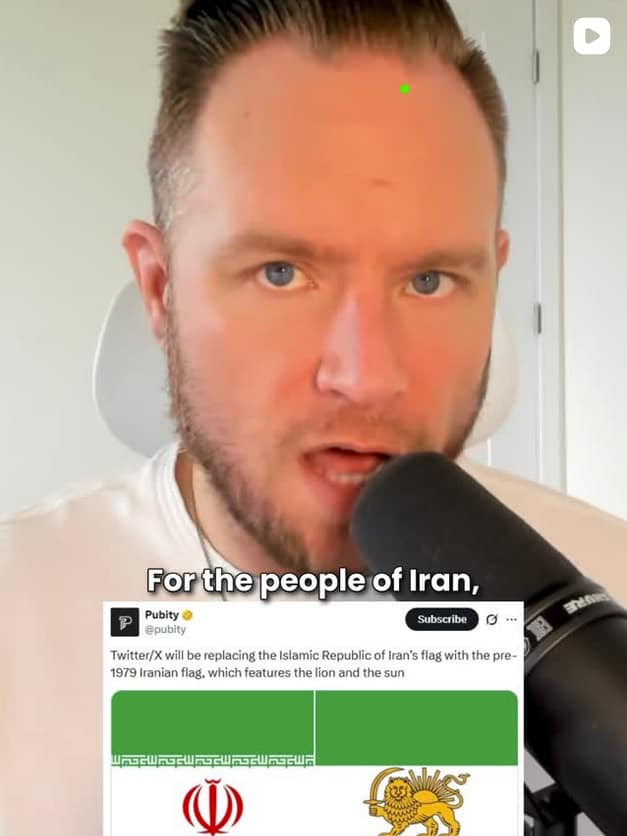
Travis Hawley woke up sick today. “A little bit of shortness of breath,” he says. “Maybe I just slept wrong or something.”
He does not yet know that in a few hours, he will be checked into a hospital for blood clots in both lungs — a potentially lethal condition he is still recovering from as I am typing this a few weeks later. But for now, he is pushing through. “I just did, like, 19 podcasts this weekend,” he says.
Travis is a cyber threat analyst with a specialized focus on Open Source Intelligence (OSINT) and information warfare. I know him primarily through his Instagram, where he exposes misinformation, calls out antisemites, and advocates for freedom for Iran, among other things.
Your content always make me feel a little better.
“I don’t know if I’m here to make anyone feel better, but I definitely am here to call out terrible people and try to be a credible person. Everyone is so political, and so toxic. I am trying to not be divisive. I’m trying to teach people how to have media literacy. Nobody knows how to use the internet, apparently, or do any research on anything, or they just don’t care to. So, yeah, I’m fighting a lot of battles here.”
With his stern speak, blue eyes and dark blond hair combed back he reminds me a bit of a benevolent Homelander.
Part I: Origin Story (The Epiphany)
“I was always interested in finding ways to connect and gain access to different communities. And I think the best way to do that is through language, because language is the gateway to their soul…”
How did you get into intelligence?
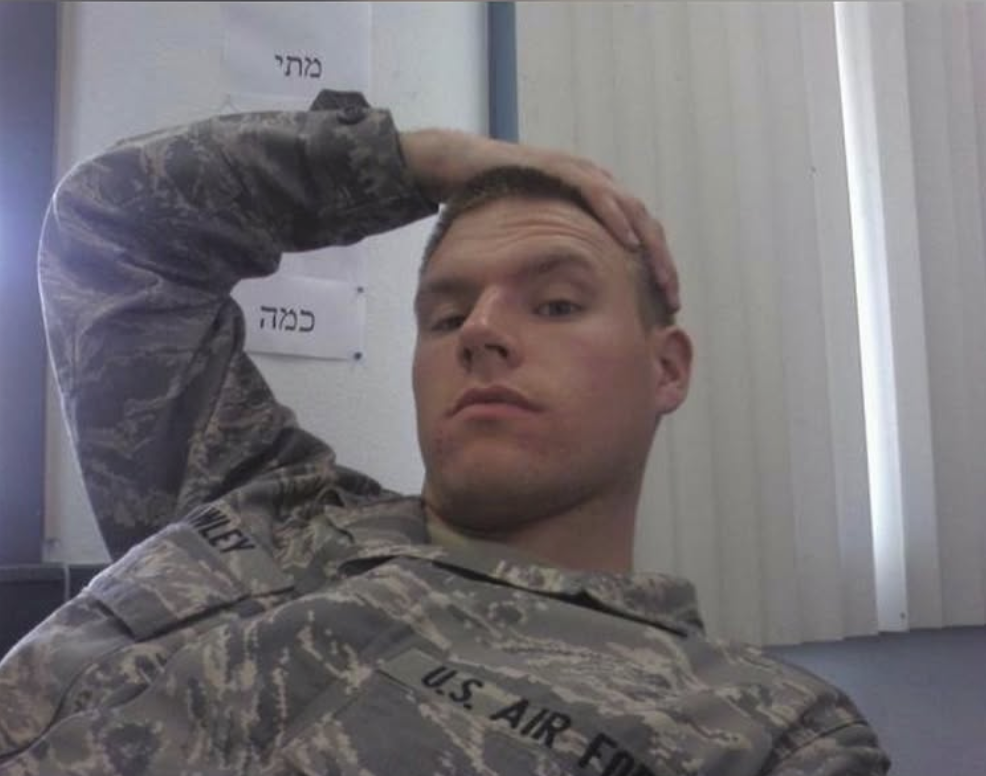
“When I joined the Air Force, I was accepted into a program to learn languages. I learned Hebrew, and my job was to — in some sense — be a bridge between Israel and the United States. I spent a few years at the National Security Agency (NSA), where I got into cyber and signals intelligence, and I even deployed to Afghanistan.
After I got out of the military, I went into marketing and media. That’s where I noticed there is a lot of crossover between communications, behavior, psychology, and technology — a lot of shared skills you can use between intelligence and marketing.”
But what made you enlist in the first place?
“Two things, one good reason, one bad reason. Well, not that bad,” he reflects.
“First of all, I’ve always wanted to be a police officer since I was a kid. Eventually I became interested in joining the military. I wasn’t really obsessed with it like some people are, but I always like had it in the back of my mind.
I grew up speaking languages. Learning languages for fun. Persian, Assyrian. I was fluent in Spanish at one point. I just love languages. I grew up around a lot of different cultures, and sometimes I was the only white guy, so I just was always interested in finding ways to connect and gain access to different communities. And I think the best way to do that is through language, because language is the gateway to their soul, their traditions, their holidays, their history, their culture. When I was young, I wasn’t thinking about it that way, but in retrospect, I can see it.
And the second reason is I was just wasting my time. I was hanging out with people just doing stupid stuff, until I was twenty years old, partying. I went to community college, but the only classes I would attend were my language classes, like Arabic and Farsi. I was a terrible student. I’m a smart person, but a terrible student because I’m so easily distracted.
At some point I found out that you can learn a language in the military. I just had this epiphany: I gotta do something with my life. So I killed two birds with one stone.”
Please tell me more about your upbringing.
“My mom’s Jewish, my dad’s not. My mom was adopted, so she was raised mostly with Catholic people, so I didn’t really have this Jewish upbringing that some people have here in America. But I decided to do Birthright, which is why I tell people that, funny enough, the first Jewish thing I ever did was Birthright.”
(Note: Birthright is a nonprofit organization that provides free educational trips to Israel for young adults of Jewish heritage.)
Did that make you want to learn Hebrew?
“A couple weeks into boot camp, they ask you, well, what languages do you want to learn? and you make a wish list. I had just come back from Israel, so I put Hebrew first. Number two, I put Persian Farsi because I had already learned how to read and write it, and I grew up with mostly Iranians. Number three, I put Serbo-Croatian because I was starting to learn how to read Russian. Long story short, I got Hebrew.
When you join the military, you have to pass a linguistic test to become a translator. I went to a recruiter and said, ‘Hey, I want to learn a language.’ She said, ‘We’re going to put you in infantry.’ I told her I only wanted to be a translator or I wasn’t joining. She said, ‘Haha, yeah, okay, sure… We’ll get you a job.’ And I told her, ‘No, you don’t understand. I’m only doing translator or I’m not joining.’
She told me most people can’t even pass the test, but if I could, we’d discuss it. The test is basically deciphering a fake language that the military created, in about two hours.”
How do you decipher it?
“They want to see your natural ability to understand and identify grammar patterns, prefixes, suffixes, and things of that nature. So I passed, obviously. And the recruiter said, ‘Holy shit, you passed!’ She didn’t even believe I would, because only a tiny percentage does. They treat you like royalty as soon as you can pass these things, because they are very hard positions to fill.”
Part II: Fighting Nihilism
CONTENT WARNING. The next part contains descriptions of child and animal exploitation.
“Nihilism is a sort of a philosophic belief that nothing matters. There’s these groups of people who are chronically online, who glorify violence, and want to sow chaos, exploit others and recruit others into this…their metric for success is harm by any means necessary.”
How do you usually describe yourself these days? A national security analyst?
“It depends who I’m talking to. If I’m talking to people in the law enforcement or government space, I might say I’m an open-source intelligence analyst. Otherwise, I might say I do digital intelligence or digital investigations — kind of like a private investigator, but I just focus on the digital world, social media, and the internet. When I go on the news, I’ll say national security analyst because I am broader in that sense; I might talk about what’s happening in Gaza, Iran, or extremism groups in the US.”
What would be your dream case? Something you’d be really invested in?
“There was one investigation that was in some ways my favorite, but is also horrific. There’s these groups called Nihilistic Violent Extremists (NVEs). It is now a category within the FBI as well.”
At this point in the conversation, he shows me his findings, trying his best not to zoom into any graphic images. Still, I had a pretty bad nightmare that night.
“Nihilism is a sort of a philosophic belief that nothing matters. So there’s these groups of people who are chronically online, who glorify violence, and want to sow chaos, exploit others and recruit others into this. If I were to use a marketing expression, their metric for success is harm by any means necessary.
What they tend to do is go into games like Roblox. They recruit children — sometimes eight or nine years old, sometimes younger. They become friends and start to groom them. They get them to send naked pictures or something like that, and use that as blackmail.
They instruct these kids to cut themselves, or brand themselves. ‘Okay, now I own you because I branded you. Now I want you to harm your pet. If you don’t, I will release your pictures to your family and school. Now you have to commit suicide and live stream it for us so my friends can watch’. It’s the most horrific stuff I’ve ever seen in my entire life.
So I go through their websites and try to get into the infrastructure. Who’s behind it? Which countries is it in? What’s the flow from Roblox to Discord, from Discord to the website, to TikTok? I try to find out where they are, get into their forums to map their leadership, capture IP addresses, and attribute their location. Then I gave my findings to the FBI.
This case changed my life. It shook me forever. This group does all the crimes — murder, suicide, arson, animal abuse, doxing, revenge porn. I know there’s the mafia, terrorists, and murderers, but to realize there’s a group that will do any of them just for the sake of it is what changed my life. Oh, they’re also super racist to Jews and Black people.”
Part III: Drop in the Ocean
“It’s not about hope for me. When you work in these realms, it’s about mitigation. How can we just minimize the suffering?”
You’re one man going after all these haters and criminals. How do you process that?
“The stakes are so high here. Even if we could only help a couple of kids, you can change someone’s life. When I’m outing some Jew-hater or something like that, yeah, it’s important, but I am under no delusion that it’s more than a drop in the bucket. In the grand scale of things, it’s meaningless compared to going after child predators.
But this is so dark and heavy. A case I did for a couple of weeks could really mess you up. If you see this stuff all day, every day, it’ll ruin you.”
How do you deal with that? How do you deal with being chronically online and just seeing the worst in people all the time?
“There’s not much you can do. You try to go to the gym, hang out with friends. You just have to escape it in healthy ways.”
Do you still have hope in humanity?
“It’s not about hope for me. When you work in these realms, it’s about mitigation. How can we just minimize the suffering? I’m not saying I’m not hopeful, but hope isn’t really something that I think about.”
What’s the next step?
“I’ve been thinking about what kinds of technology we can use to scale what we’re doing. We need a hundred of me to truly have a measurable impact. Everyone in law enforcement is at their limit. There’s just so much crime and and just evil fucking people, especially on the internet. I can’t create more time, so we need to automate certain pieces so OSINT analysts can do more. One of the cons of AI is it’s going to take some jobs, which sucks. But if I can save more people, I can sleep at night.”
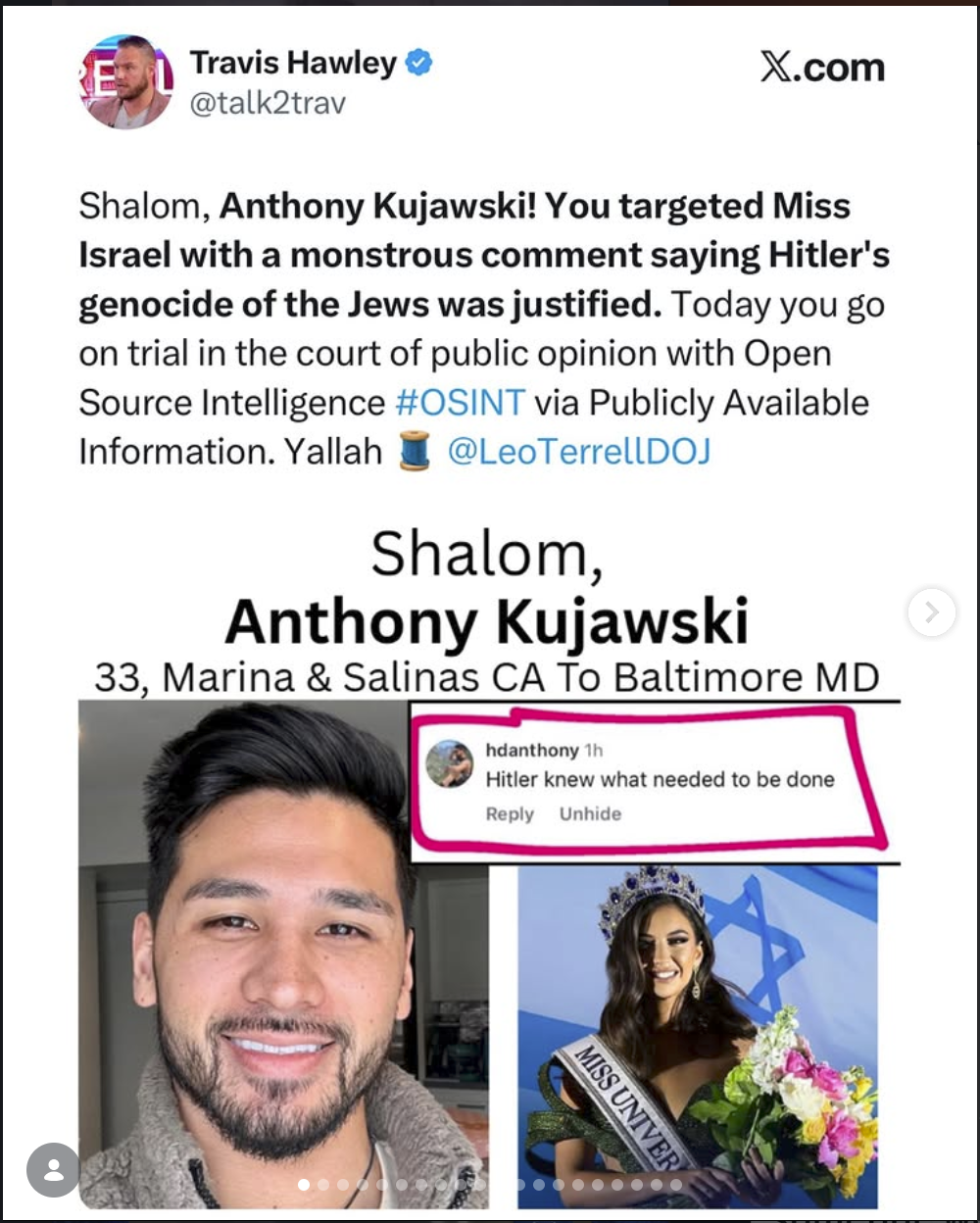
When you go after these haters — for example, this guy who commented “Hitler knew what needed to be done” on a photo of Miss Israel— despite it being a drop in the ocean, is there a message you’re trying to get across?
“When you put somebody on the spot, it’s essentially, ‘fuck around and find out.’ You have your freedom of speech to be hateful, but I have my freedom to absolutely drag you publicly. You’re so confident in your hatred? I will raise the bar. I’ll give you the attention you want.
They may not be breaking the law, but they need to be held accountable in the court of public opinion. Those things you said? Stand by them, because now they’ll be on the first page of Google for the foreseeable future when anyone looks you up.”
I usually wrap up by asking people if there’s a movie or a book that inspires them. Is there a book or TV show that makes you say, that’s my life?
“Have you ever seen Homeland? I love it. What I like is the complexity of the moral and human elements of intelligence. Carrie Mathison has mental health issues, and sometimes they help her be a better analyst, and sometimes they wreck her.
Another one I like — a little bit darker — is Dexter. Obviously, I don’t agree with taking the law into your own hands and killing people, but I like the premise of holding people accountable when they get away with horrible stuff. I’ve never killed a person like that, but in some ways, I feel like hacker-type people can be digital Dexters. You think you can skirt away, hide in the shadows, and lie without getting caught? Then a digital Dexter steps in and holds you accountable in some other way.”
The Digital Dexter: He Learned Hebrew in the U.S Air Force. Now He Hunts Child Predators Online. was originally published in OSINT Team on Medium, where people are continuing the conversation by highlighting and responding to this story.